• News
  • Blog
  • Contact
Media Art League /en
Menu   ≡ ╳
  • JAPANESE
  • HOME
  • Introduction
    • Mission
    • Objective
    • Activities
    • Chronology
    • Clients
  • Our Work
    • Screenings
    • Photo Exhibitions
    • Book Projects
    • Media Coverage
    • Media Contributions
    • Media Assignments
  • Creative Projects
    • Artwork Production
    • CSR Projects
    • Photography Projects
    • Web Media Production
    • Design Projects
  • Publishing & Educational Activities
    • Publishing Activities
    • Book Publications
    • Book Reviews & Interviews
    • Photography Textbooks & Essays
    • Lectures & Workshops
  • International Communications
    • International Editorial Contributions
    • Research Projects
    • High End Translation
    • Clients
    • Profile of Andreas Boettcher
  • MIRO ITO + NPO Activity
    • Mission Statement
    • Purport & Objective
    • Activities & Structural Configuration
    • Founding, Vision & Contribution

Media Art League

Media + Art = Message No.17: Emperor Shōmu’s True Motives for the Construction of the Great Buddha—‘For a world in which all things—flora and fauna alike—may flourish’

2026-10-17

The ‘Road of Light and Hope’ photography exhibition of Tōdai-ji’s National Treasures (by MIRO ITO) opened on 29 September, at the University of Salamanca in Spain. After being held at the United Nations Headquarters in New York in May 2016, this is its13th venue in 11 countries on world tour.
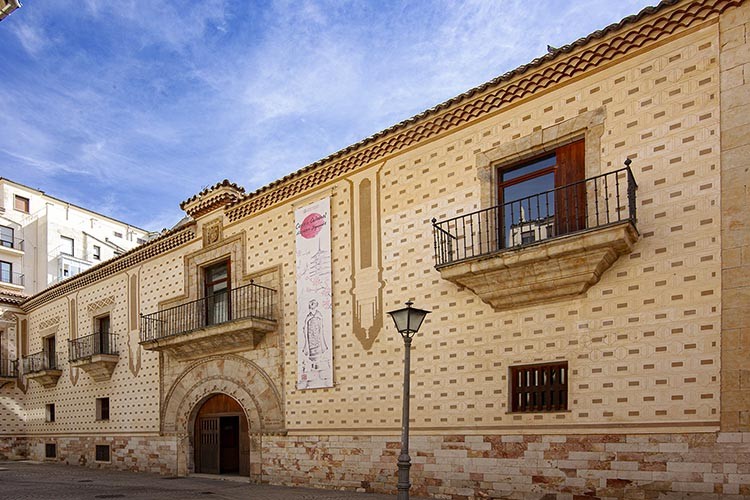
Spanish-Japanese Cultural Center (Palacio de San Boal), Salamanca


This exhibition promotes the all-encompassing worldview of the Huayan (Kegon in Japanese) philosophy, which holds that ‘all things are interconnected and everything is linked as one’. Around 1,300 years ago, in a time of national crisis, when Japan suffered major earthquakes and famines while smallpox was rampant, Emperor Shōmu issued an imperial edict in 743 CE ordering the construction of the Great Buddha—as a catalyst of national unity.

Over half of the nation’s estimated 5 million population heeded Shōmu’s appeal to help create the statue: ‘even with just a single stem of straw and a handful of earth’.
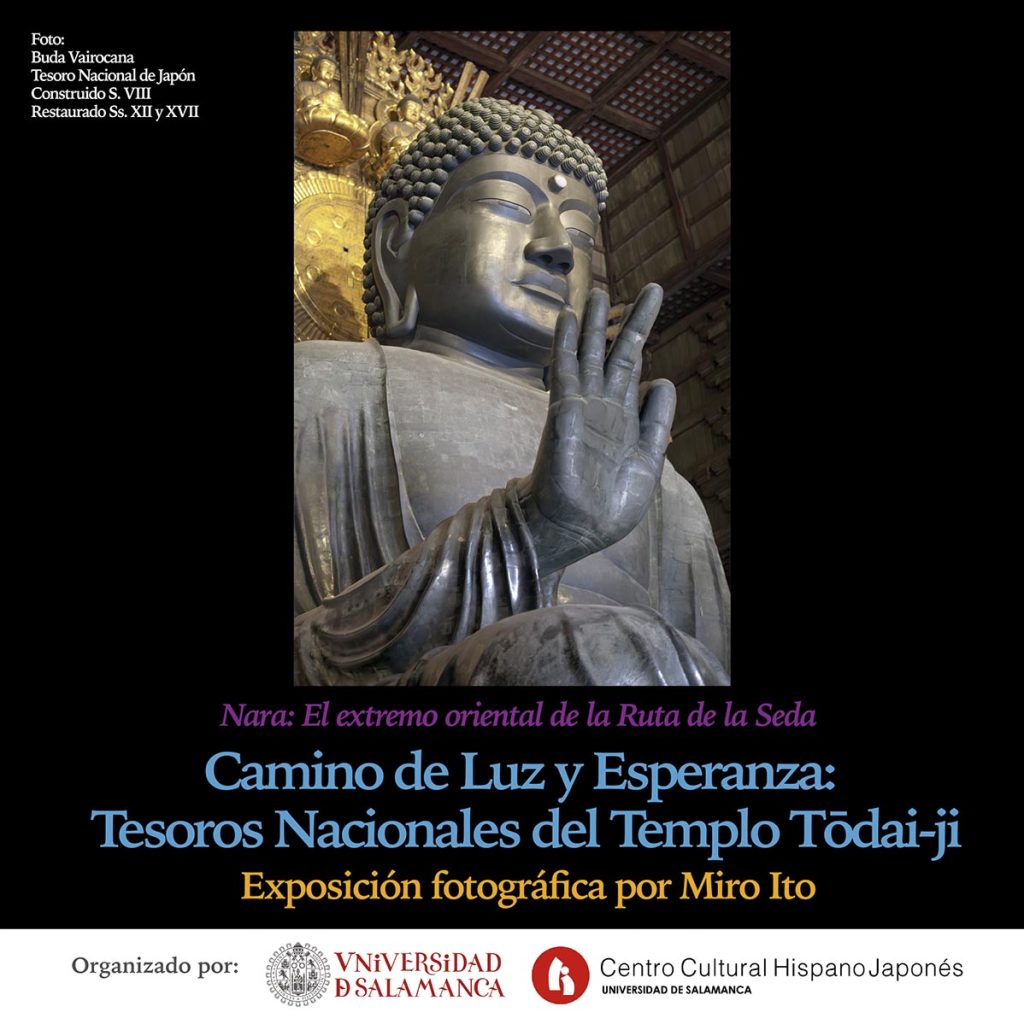
Brochure (‘Road of Light and Hope: National Treasures of Tōdai-ji Temple by Miro Ito)


That nothing in this world exists in isolation; that everything is infinitely interconnected and interrelated; that all things are one—this message should be embraced by all as something extremely important that we can do in our everyday lives. Even though the empathy of one individual may only be a tiny ripple, it can resonate through the whole world as through a tuning fork.
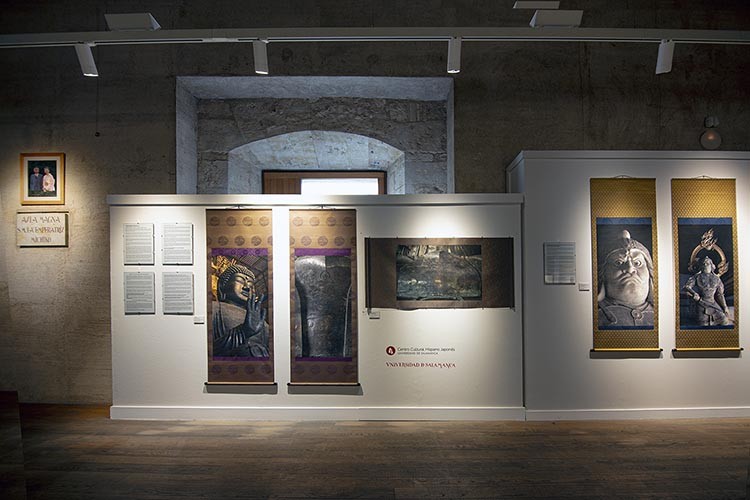
“Empress Michiko Hall”: The only venue in the world permitted to bear the name of a former Empress (with a photograph of retired emperor & empress displayed in the top left-hand corner)


🔸Unraveling the History of East-West Exchange: From National Treasures to Important Cultural Properties, including hidden Buddhist statues

Another focus of this exhibition is to trace the history of East-West cultural exchange and highlight the commonalities between East and West as well as North and South within cultures.
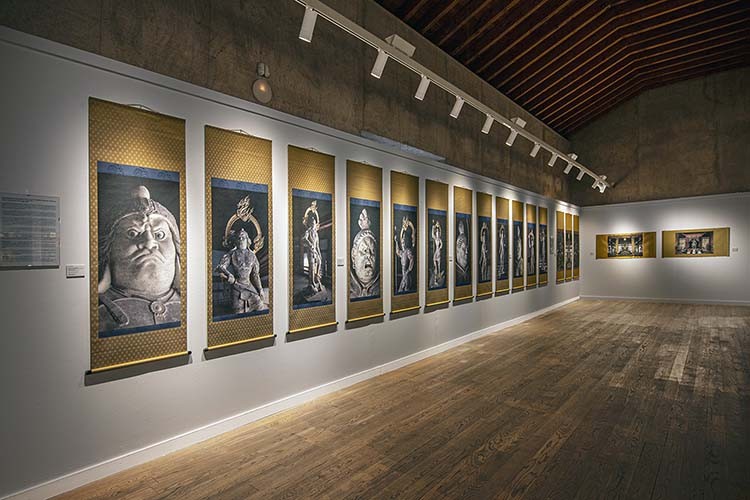
Four Heavenly Kings (Kaidan-dō) and two photographs depicting Hokke-dō’s inner sanctum (back of right side)


During the golden age of the Tang Dynasty (712–765), centered on the reign of Emperor Xuanzong and known as the ‘High Tang’, the capital of Chang’an saw the blossoming of a culture of unprecedented international diversity, fueled by trade along the Silk Road. This remarkable international character and diversity were also introduced to Heijō-kyō (710–794), Japan’s imperial capital at the time. Today, Nara, along with Chang’an (Xi’an) across the sea, are known as the ‘easternmost terminus of the Silk Road
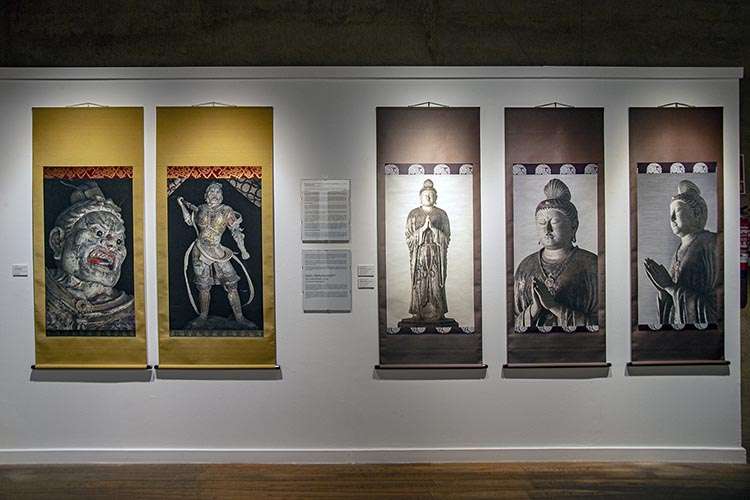
Hidden statue of Vajrapani in the Hokke-dō (left) and statue of Indra (Gakkō)


In this exhibition, we explore the points of convergence between the zeniths of Eastern and Western aesthetic traditions, as seen in a collection of 8th-century National Treasure Buddhist statues (Japanese National Treasures), which were photographed with special permission from Tōdai-ji Temple. These include the hidden statue of Vajrapani in the Hokke-dō, which has its origins in Hercules, and the Four Heavenly Kings statues in the Kaidan-dō, which follow the realistic style of classical Greek art, and the statues traditionally attributed to Nikkō and Gakkō (representing Indra and Brahma), which were originally part of the same ensemble: an impressive collection of masterpieces of Nara-period clay-sculpture
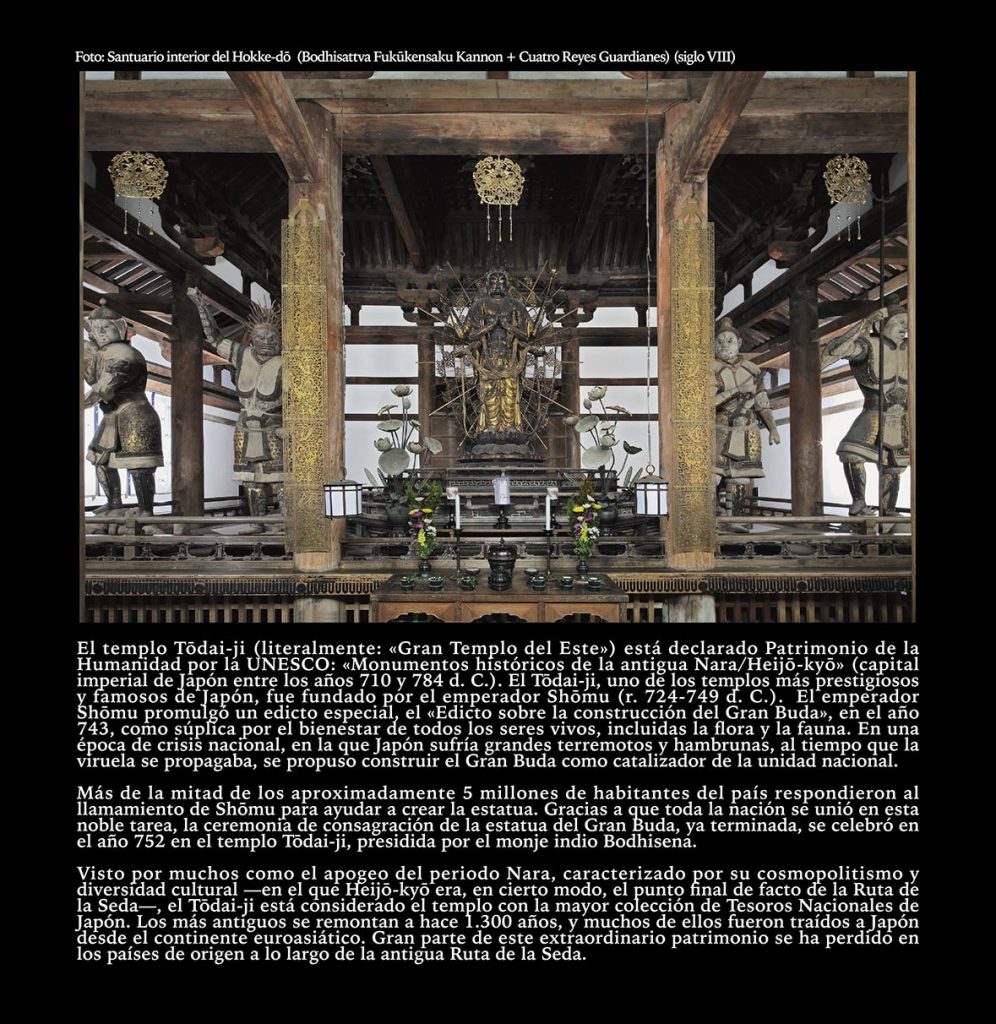
Inner Sanctum of Hokke-dō (Principle image: Fukūkensaku Kannon)/ Brochure: ‘Camino de Luz y Esperanza: Tesoros Nacionales del Templo Tōdai-ji por Miro Ito


Furthermore, an ancient Greek historian once pointed out that the statue of the Bodhisattva Fukūkensaku Kannon (Sanskrit: Amoghapāśa) in the Hokke-dō is also linked to Hercules through its association with the god Shiva.
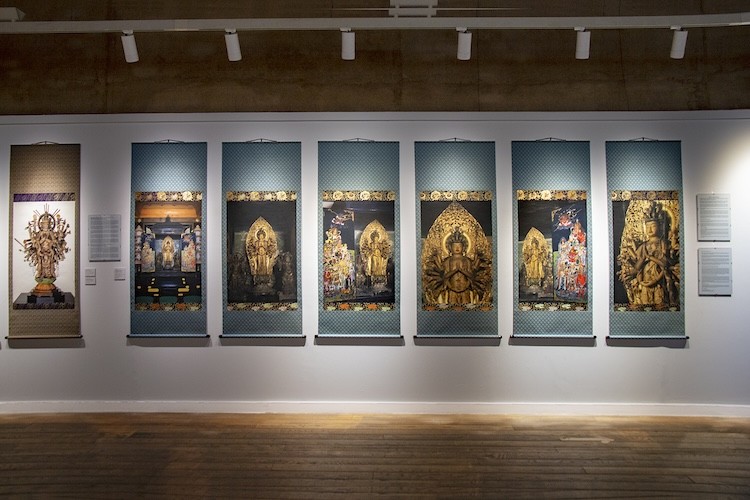
Senju Kannon/Thousand-Armed Kannon statues: Tōdai-ji Museum and Senju-dō


In addition, the Eleven-Headed Bodhisattva statue (11~12 centuries), the principal image enshrined in the Shigatsu-dō Hall at Tōdai-ji, and the Thousand-Armed Kannon statue (13 century)—a secret statue enshrined in the Senjūdō Hall—also add a unique touch to the exhibition.
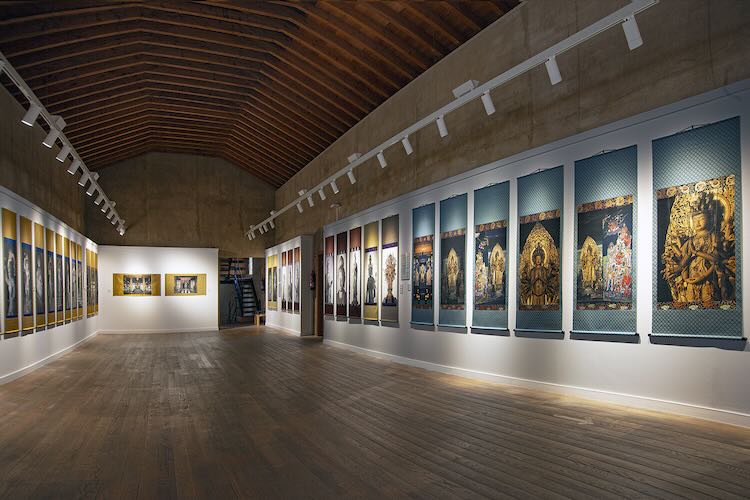
Senju Kannon/Thousand-Armed Kannon statues: Tōdai-ji Museum and Senju-dō (right side wall: from the right to middle)
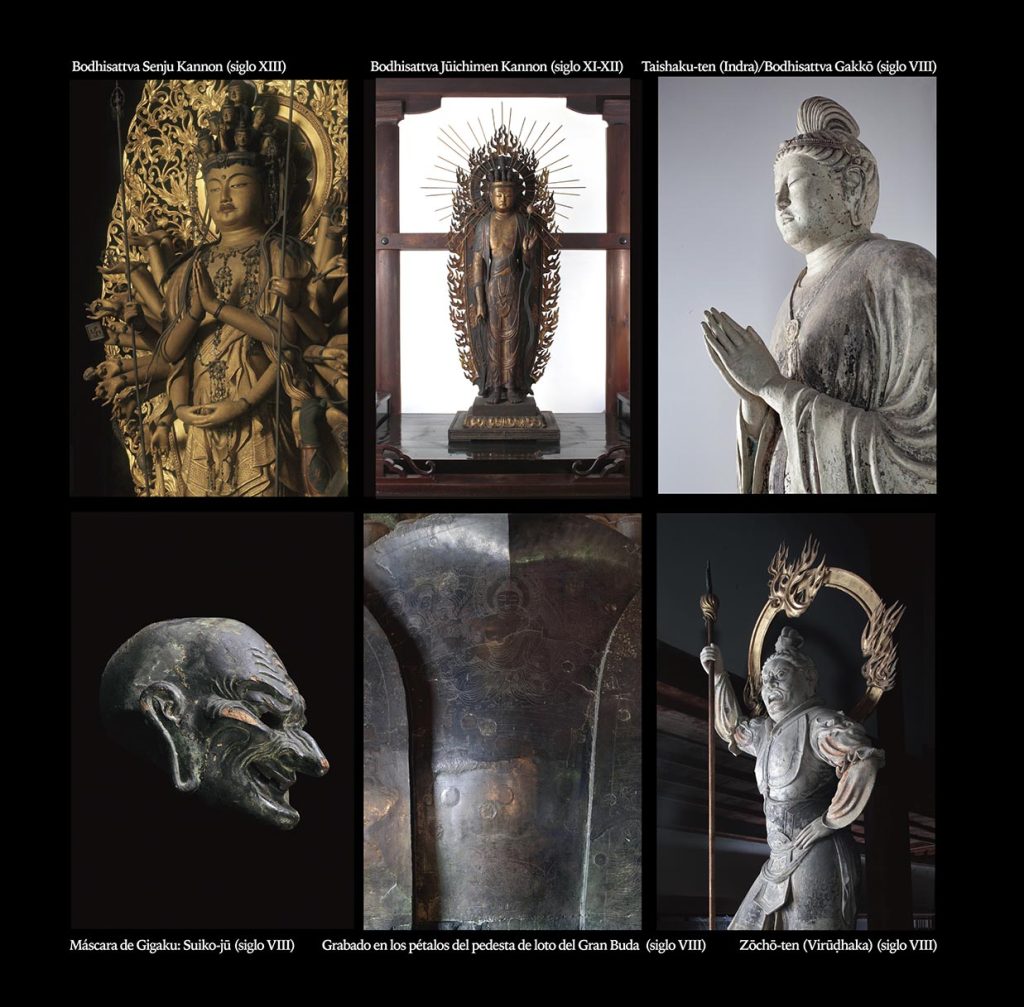
(Brochure: ‘Camino de Luz y Esperanza: Tesoros Nacionales del Templo Tōdai-ji por Miro Ito)


The exhibits also include such photographs as the 8th century Gagaku masks from Tōdai-ji—which bring together performing arts and folk traditions from along the Oasis Route—as well as the 12 century Bugaku masks—a collection of court performing arts from along the Maritime Silk Road—belonging to the Kasuga-Taisha Shrine; both sites are part of the UNESCO World Cultural Heritage Site: Historic Monuments of Ancient Nara.
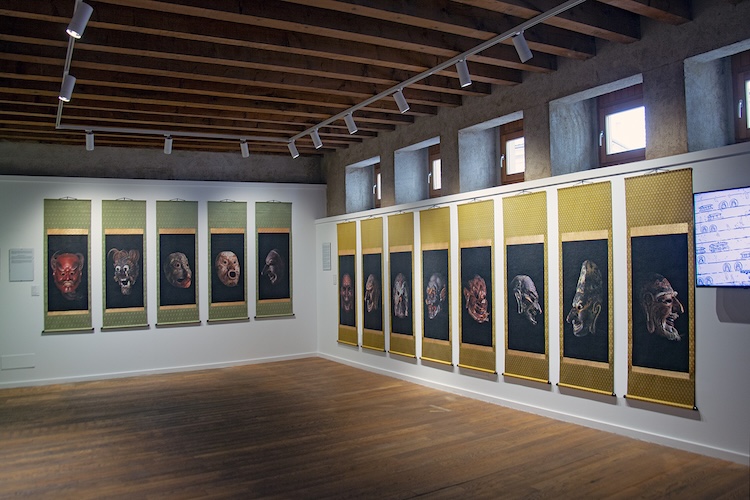
Gigaku masks of Tōdai-ji (right wall) and Bugaku masks of Kasuga-Taisha Shrine
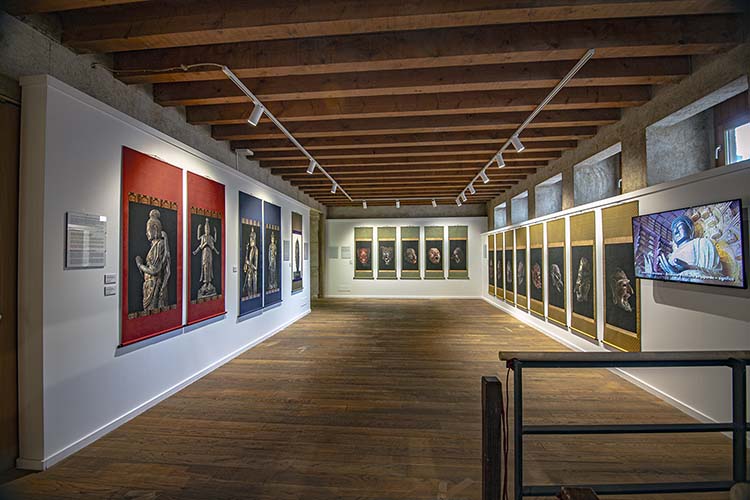
Gigaku masks of Tōdai-ji (right wall) and Bugaku masks of Kasuga-Taisha Shrine (middle wall) and Buddhist statues of Daianji (left) and Shorin-ji (middle in left wall)


The masterpieces of the Buddhist sculpture art of the 8th century of Daian-ji and Shōrin-ji will be also added in the coming venue in Salamanca. Furthermore, a new short film by Miro Ito will be screened on site (in Spanish): The Vairocana Buddha of Tōdai-ji Temple: Formation of Cosmic Life-Force and Light of Wisdom.
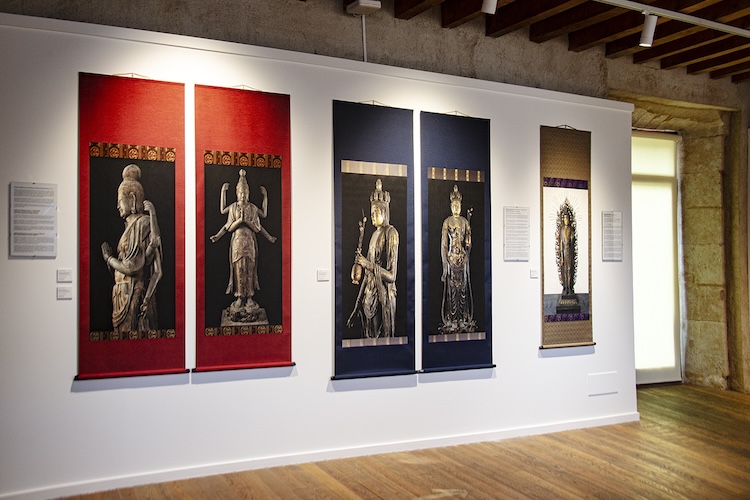
Buddhist statues of Daianji (left), Shōrin-ji (middle) and Tōdai-ji Temples


🔸Opening Ceremony

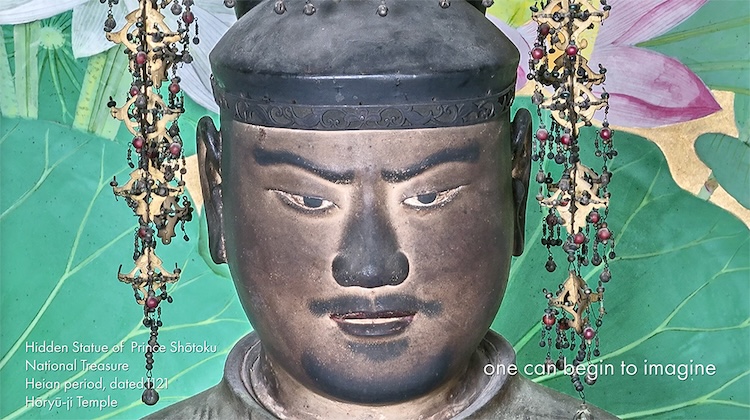
The National Treasures featured in this exhibition are represented by two life-size statues of Prince Shōtoku—both considered to be ‘hidden Buddha’ statues: a Kannon of Salvation from the Asuka period (early to mid-7th century) and a statue of Prince Shōtoku (Regent Statue, 1122) created 500 years after his death in 622 CE.

The Kudara Kannon statue, exhibited at the Louvre in 1997, and the Yumechigai Kannon (lit. Dream Changer) statue, exhibited at the British Museum in 2019, also add to the exhibition’s appeal. Two more important statues—the two-year-old and the sixteen-year-old Prince Shōtoku—which were created as Prince Shōtoku’s beliefs spread, are Important Cultural Property from Gangō-ji (formerly Hōkō-ji), Japan’s first Buddhist temple.
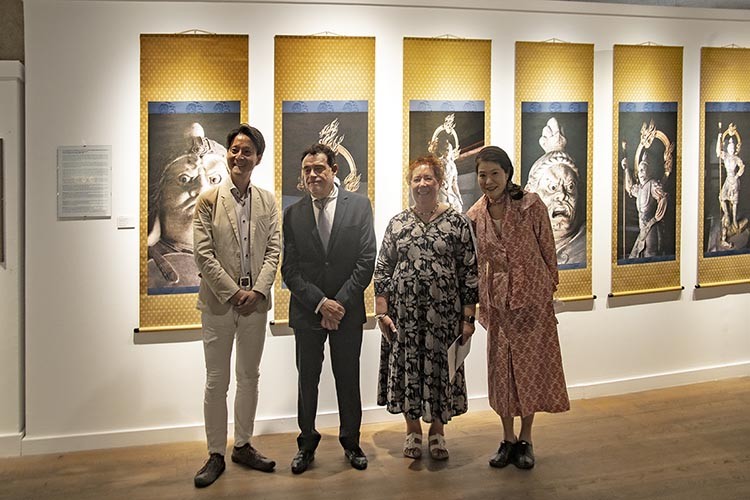
From left to right: Mr. Takeda, Mr. Flores, Ms. Martinez and Miro Ito
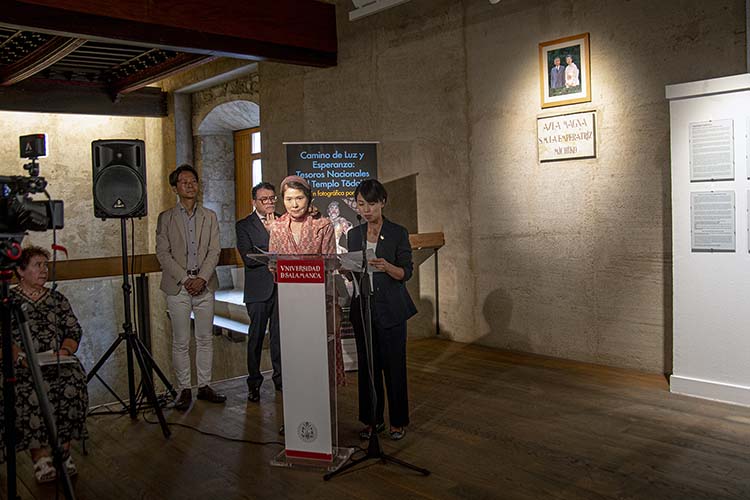
Inauguration speech by Miro Ito (translated into Spanish by Ms. Sugiyama)


Dates: 29th September to 18th December 2026

Opening hours: Monday to Friday (11:00 AM to 1:45 PM, 5:30 PM to 8:45 PM)

Address: Pl. de San Boal, 13, 37002 Salamanca, Spain

Tel: +34 923 29 45 60

EXPOSICIÓN: Camino de Luz y Esperanza

Organised by: Spanish-Japanese Cultural Center, University of Salamanca(Centro Cultural Hispano Japonés, Universidad de Salamanca)
Co-organised by: Media Art League + Japan Camera Industry Institute
Concept and Production: Media Art League

Photo permits by: Tōdai-ji, Daian-ji, Shōrin-j Temples; Kasuga-Taisha Shrine, Nara National Museum

Photography, text and video by: Miro Ito
English editing by: Andreas Boettcher
Spanish editing by: Spanish-Japanese Cultural Center, University of Salamanca
Endorsed by: Embassy of Japan in Spain; Japan Foundation, Madrid
2026 (C) Photographs & text by Miro Ito/Media Art League. All rights reserved.


🔸More Information

FUNDACIÓN JAPÓN MADRID
https://md.jpf.go.jp/es/Actividades/Eventos-organizados-por-otras-instituciones/evento/400/camino-de-luz-y-esperanza-202609291218

Media + Art = Message No.16: Quest for the wisdom of our forebears seeking global harmony―Miro Ito’s Hōryū-ji photo exhibition at the University of Salamanca in Spain runs until 19 June 2026

2026-06-06

🔸Quest for the wisdom of our forebears seeking global harmony

In a world fraught with uncertainty, one way to continue to inspire a yearning for peace is by learning from the wisdom and achievements of those who came before us. After personally experiencing the 9/11 terrorist attacks in New York, I sought such wisdom from my forebears in Japan. The achievements of Prince Shōtoku (aka Prince Umayado, 574–622)—a sage synonymous with the origins of Japanese culture—soon emerged as a central theme.

🔸First overseas photography exhibition featuring Horyu-ji’s National Treasures

The photographic exhibition ‘Historical Significance of Hōryū-ji Temple and Prince Shōtoku’ (by MIRO ITO/Japan Authentic Heritage Initiative & Media Art League) is ongoing at the Spanish-Japanese Cultural Center, University of Salamanca in Spain until 19 June 2026. This exhibition, the first overseas exhibition featuring Hōryū-ji’s National Treasures (in a luxurious hanging-scroll photography format, opened on 17 March to mark the 25th Salamanca Japanese Culture Week.

Prince Shōtoku: Scene from “Historical Significance of Hōryū-ji Temple and Prince Shōtoku” (short film by Miro Ito, English version)

🔸Hōryū-ji: the Cradle of Japanese art

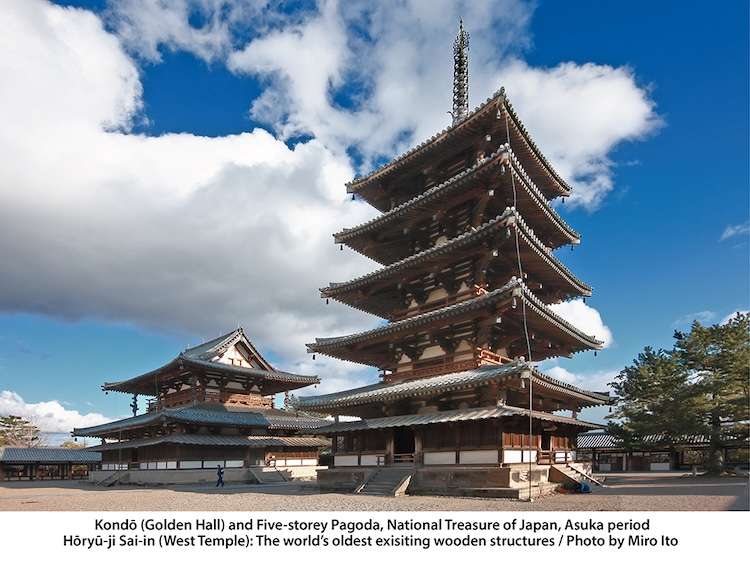
The Hōryū-ji is renowned for having the world’s oldest surviving ensemble of wooden buildings and is the first site in Japan to be designated as a UNESCO World Cultural Heritage. This invaluable collection of Buddhist art, that includes numerous National Treasures and designated cultural property that epitomise the cultural zenith of East Asia during the 7th century (the Asuka period). Drawing on Buddhist art from China and the Korean Peninsula, thes artistic masterpieces—which underwent uniquely Japanese refinements—are regarded as the cradle of Japanese art and artisanship.

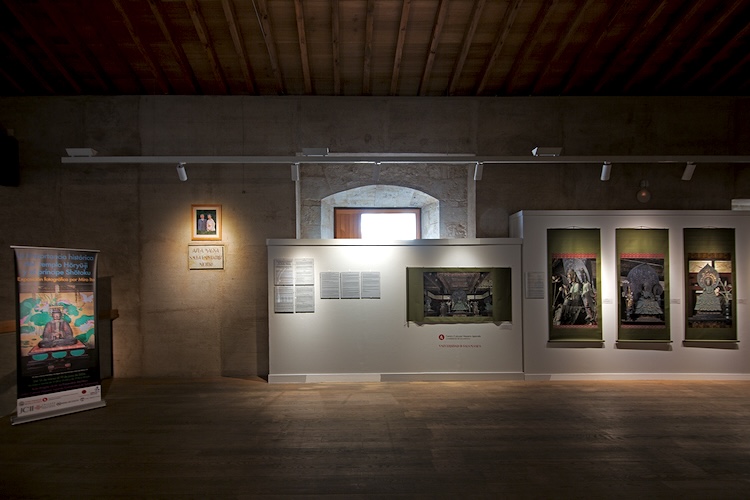
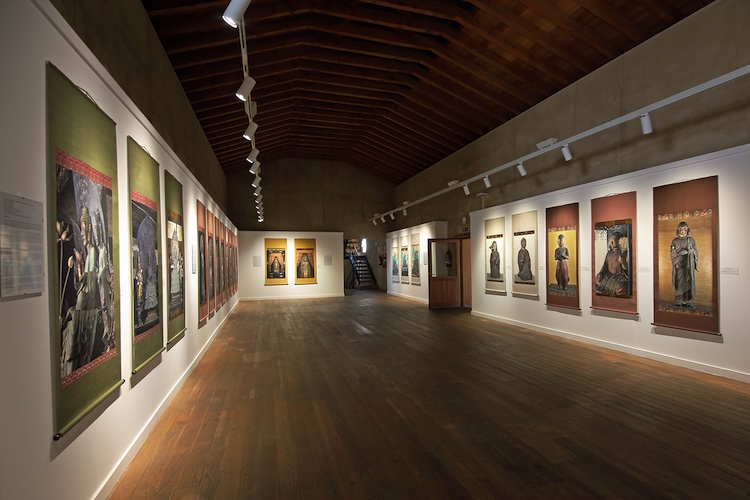
The exhibition hall—the only one in the world allowed to bear the name of Empress Michiko—is adorned with photographs of her and retired Emperor Emeritus Akihito (Photo: Japan Authentic Heritage Initiative)

🔸National Treasure Masterpieces of the 7th century

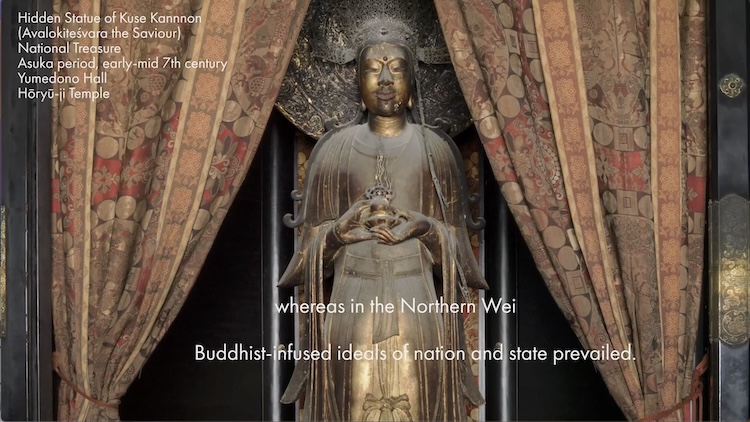
The National Treasures featured in this exhibition are represented by two life-size statues of Prince Shōtoku—both considered to be ‘hidden Buddha’ statues: a Kannon of Salvation from the Asuka period (early to mid-7th century) and a statue of Prince Shōtoku (Regent Statue, 1122) created 500 years after his death in 622 CE.

A view of the exhibition “La importancia histórica del templo Hōryū-ji y el príncipe Shōtoku”: Hidden Statue of Kuse Kannon (left) and Hidden Statue of Prince Shotoku (right)

Kuse Kannon: Scene from “Historical Significance of Hōryū-ji Temple and Prince Shōtoku” (short film by Miro Ito, English version)

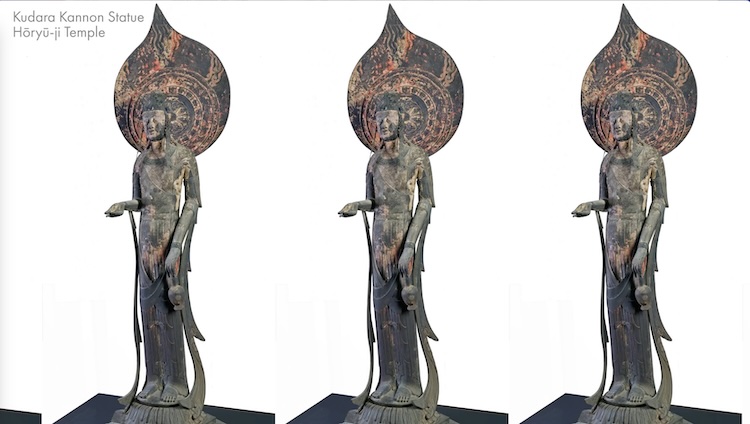
Kudara Kannon: Scene from: ‘Historical Significance of Hōryū-ji Temple and Prince Shōtoku’ (short film by Miro Ito)

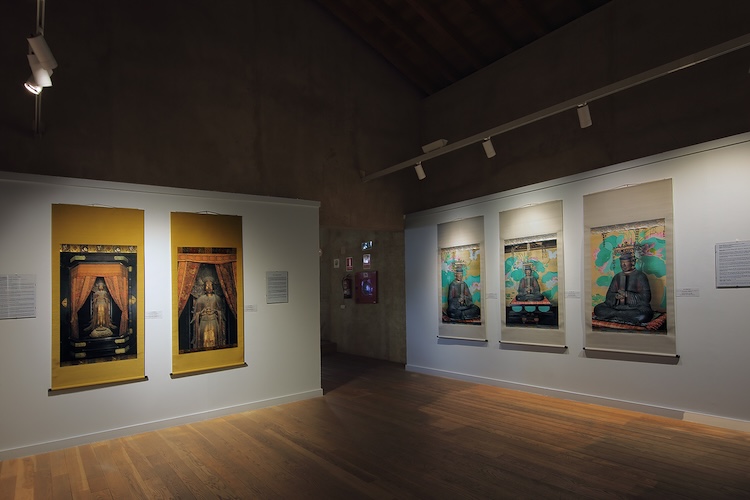
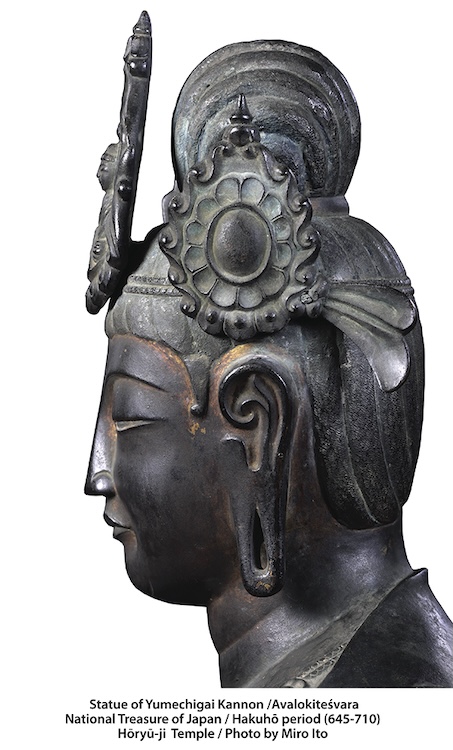
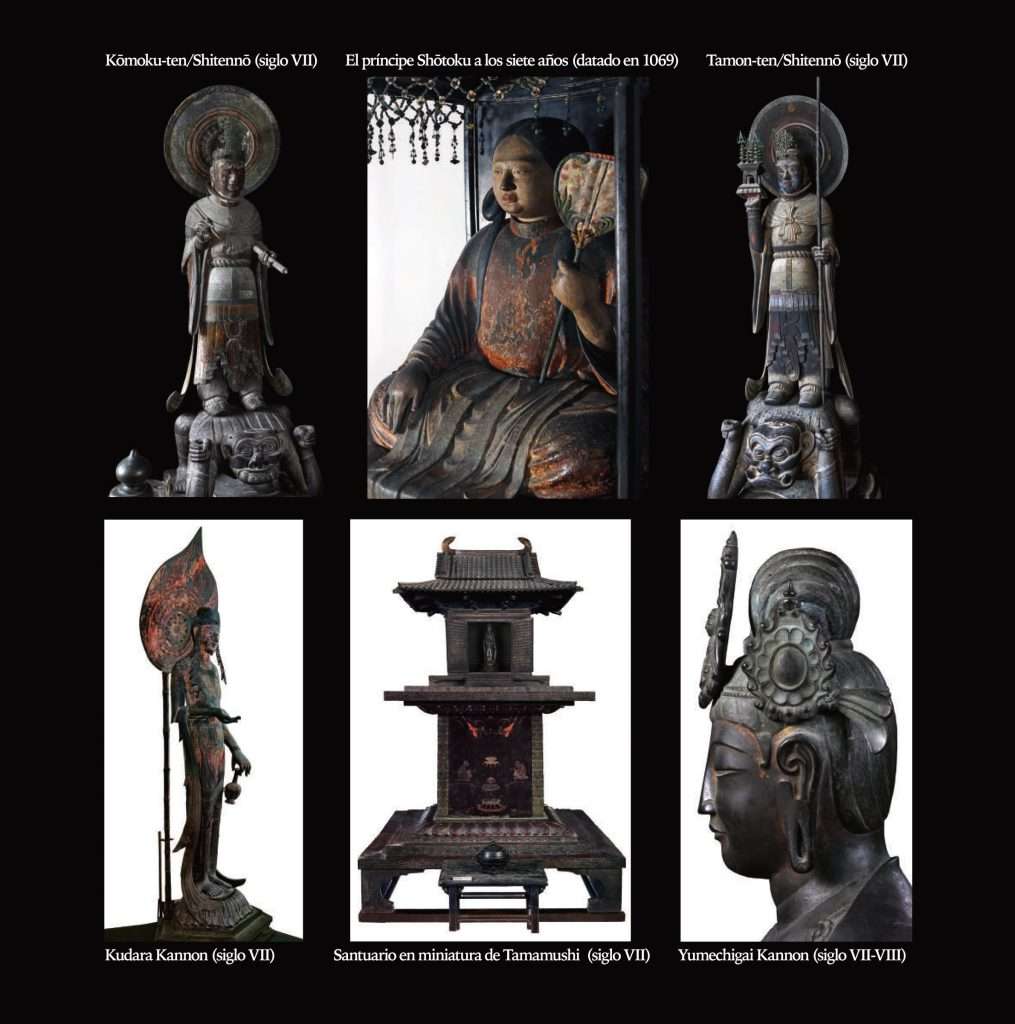
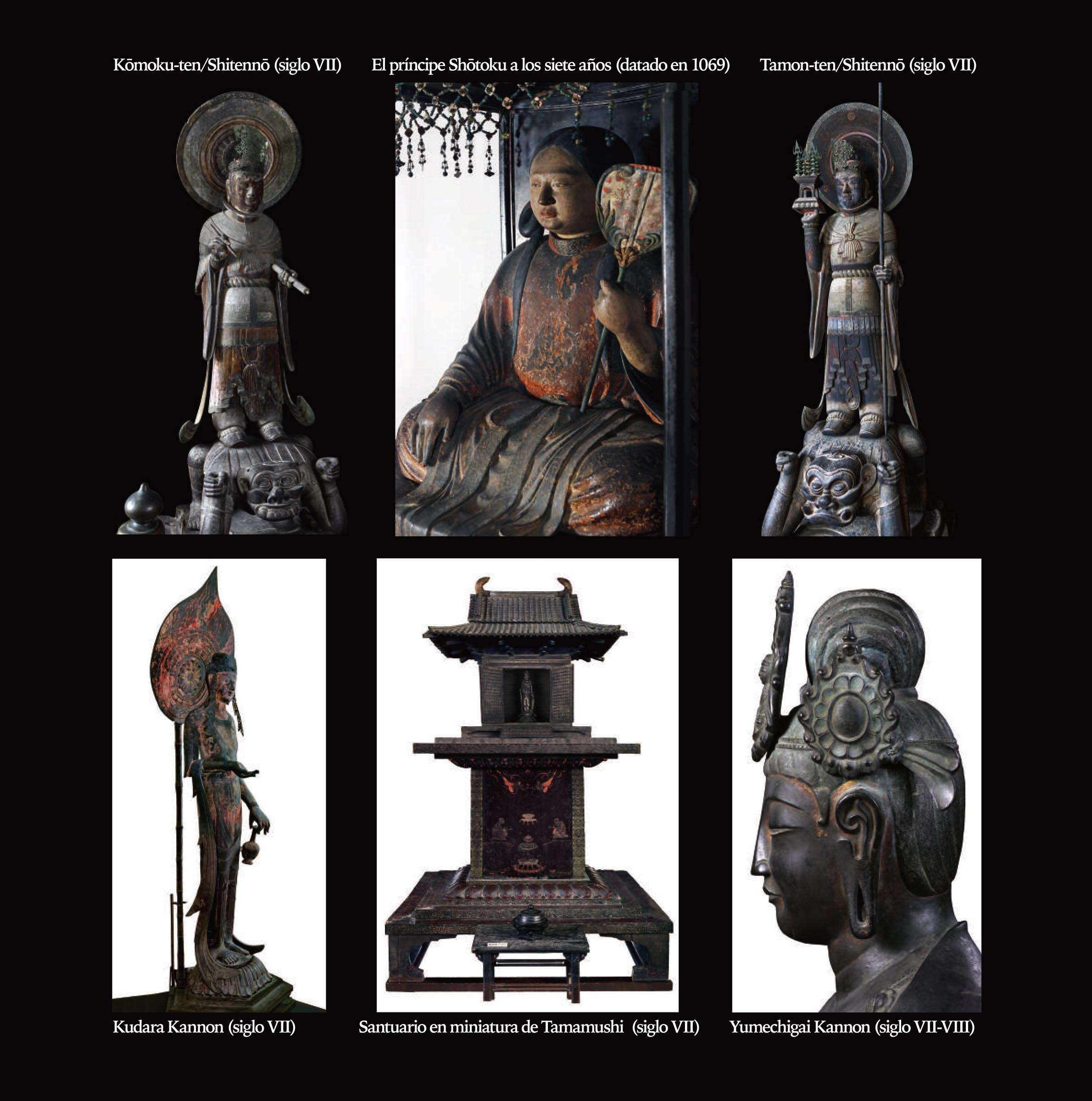
The Kudara Kannon statue, exhibited at the Louvre in 1997, and the Yumechigai Kannon (lit. Dream Changer) statue, exhibited at the British Museum in 2019, also add to the exhibition’s appeal. Two more important statues—the two-year-old and the sixteen-year-old Prince Shōtoku—which were created as Prince Shōtoku’s beliefs spread, are Important Cultural Property from Gangō-ji (formerly Hōkō-ji), Japan’s first Buddhist temple.

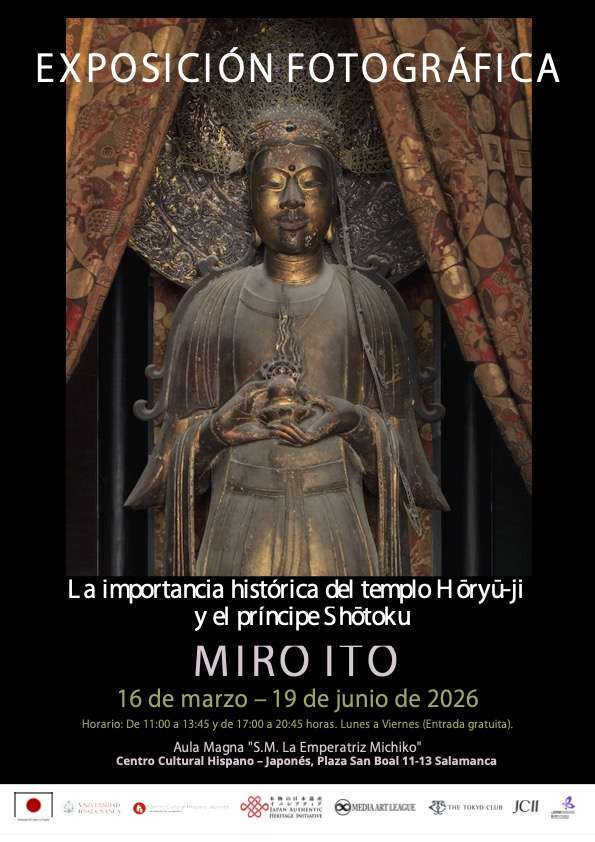
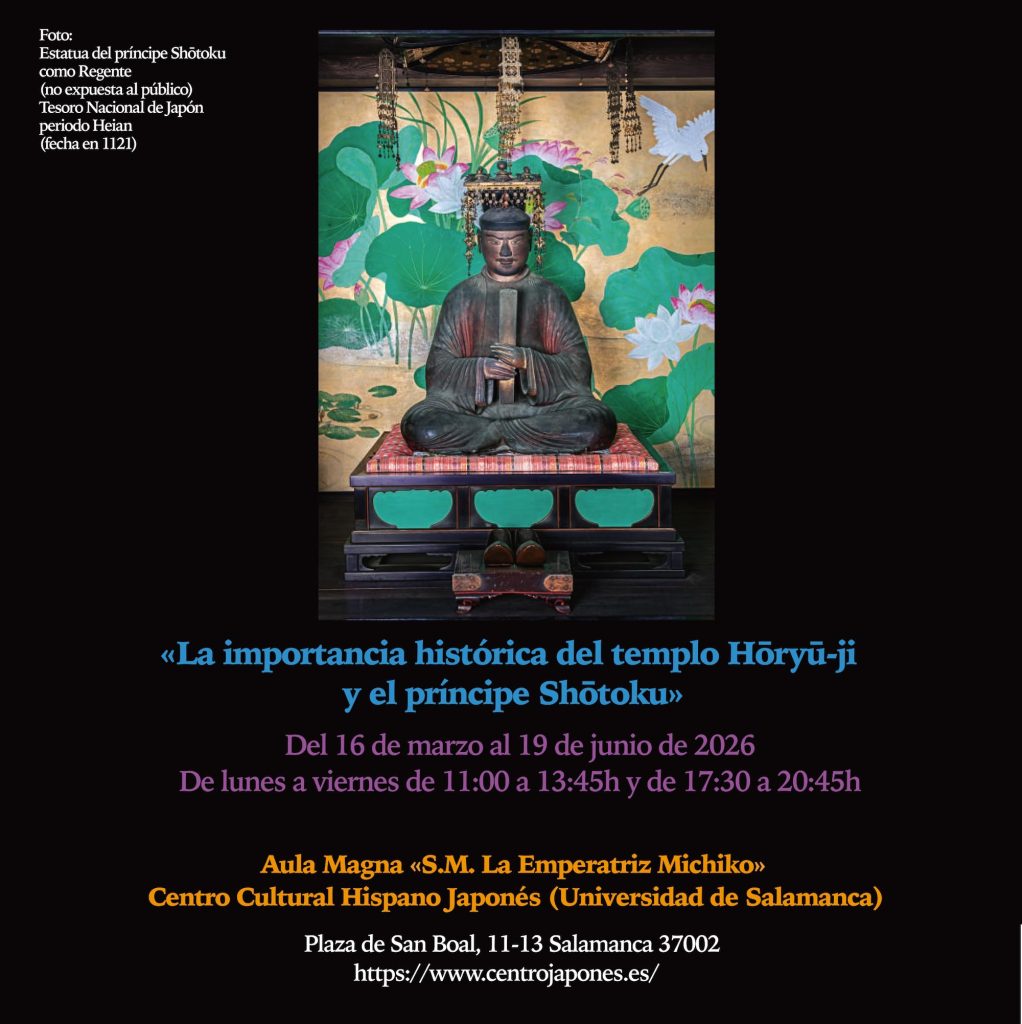
Prospectus: La importancia histórica del templo Hōryū-ji y el príncipe Shōtoku

A view of the exhibition “La importancia histórica del templo Hōryū-ji y el príncipe Shōtoku”: Prince Shōtoku statues of Hōrryū-ji and Gangōr-ji Temples (far right and third from right) (Photo: Japan Authentic Heritage Initiative)


🔸Prince Shōtoku’s aspirations for peace

Having created the basis of Japan as a nation in terms of social system, religion, philosophy, education and fine arts; Prince Shōtoku embodies the origins of Japan’s culture. This exhibition offers a rare opportunity to view global treasures that showcase the finest examples of 7th-century East Asian art—not only from Japan but from across the region—in the context of Prince Shōtoku’s aspirations for peace, dating back more than 1,400 years.

Artist/creator MIRO ITO, obtained special permission from the Hōryū-ji and invested 20 years to take these photographs and videos.The exhibition will be open until 19th June 2026, and the public is welcome to view it in the Hall of Her Empress Michiko (Palace of San Boal) at the University of Salamanca—Europe’s fourth-oldest university—at the heart of the World Cultural Heritage city of Salamanca.

La importancia histórica del templo Hōryū-ji y el príncipe Shōtoku (The Historical Significance of Hōryū-ji and Prince Shōtoku)

Centro Cultural Hispano Japonés (Universidad de Salamanca)

Dates: 16th March to 19th June 2026

Opening hours: Monday to Friday (11:00 AM to 1:45 PM, 5:30 PM to 8:45 PM)

Address: Pl. de San Boal, 13, 37002 Salamanca, Spain

Tel: +34 923 29 45 60

URL: https://www.centrojapones.es/exposicion-templo-horyuji-2026/

Organised by: The Spanish-Japanese Cultural Center, University of Salamanca(Centro Cultural Hispano Japonés, Universidad de Salamanca)
Co-organised by: Japan Camera Industry Institute, Japan Authentic Heritage Initiative
Concept and Production: Media Art League Photo permits by: Hōryū-ji Temple
Photography, text and video by: Miro Ito
English editing by: Andreas Boettcher
Spanish editing by: The Spanish-Japanese Cultural Center, University of Salamanca
Endorsed by: Embassy of Japan in Spain; Japan Foundation, Madrid
Production of cine-poetry: Nara Prefecture Funded by: The Tokyo Club


🔸More Information

JAPAN AUTHENTIC HERITAGE (previous blog)

JUST LAUNCHED—A project to spread Prince Shotoku’s ideal of harmony around the world

MEDIA ART LEAGUE (previous blog No.15)

https://mediaartleague.org/en/blog/media-art-message-no-15/

TRIBUNA SALAMANCA

https://www.tribunasalamanca.com/noticias/438030/japon-desembarca-en-salamanca-una-semana-de-arte-gastronomia-y-tradicion-en-la-universidad

FUNDACIÓN JAPÓN MADRID
https://md.jpf.go.jp/es/Actividades/Eventos-organizados-por-otras-instituciones/evento/351/exposicion-fotografica-miro-ito-salamanca

SALAMANCA.COM

https://www.salamanca.com/evento/la-importancia-historica-del-templo-horyu-ji-y-el-principe-shotoku-en-el-cchj-exposicion-en-salamanca-2026/

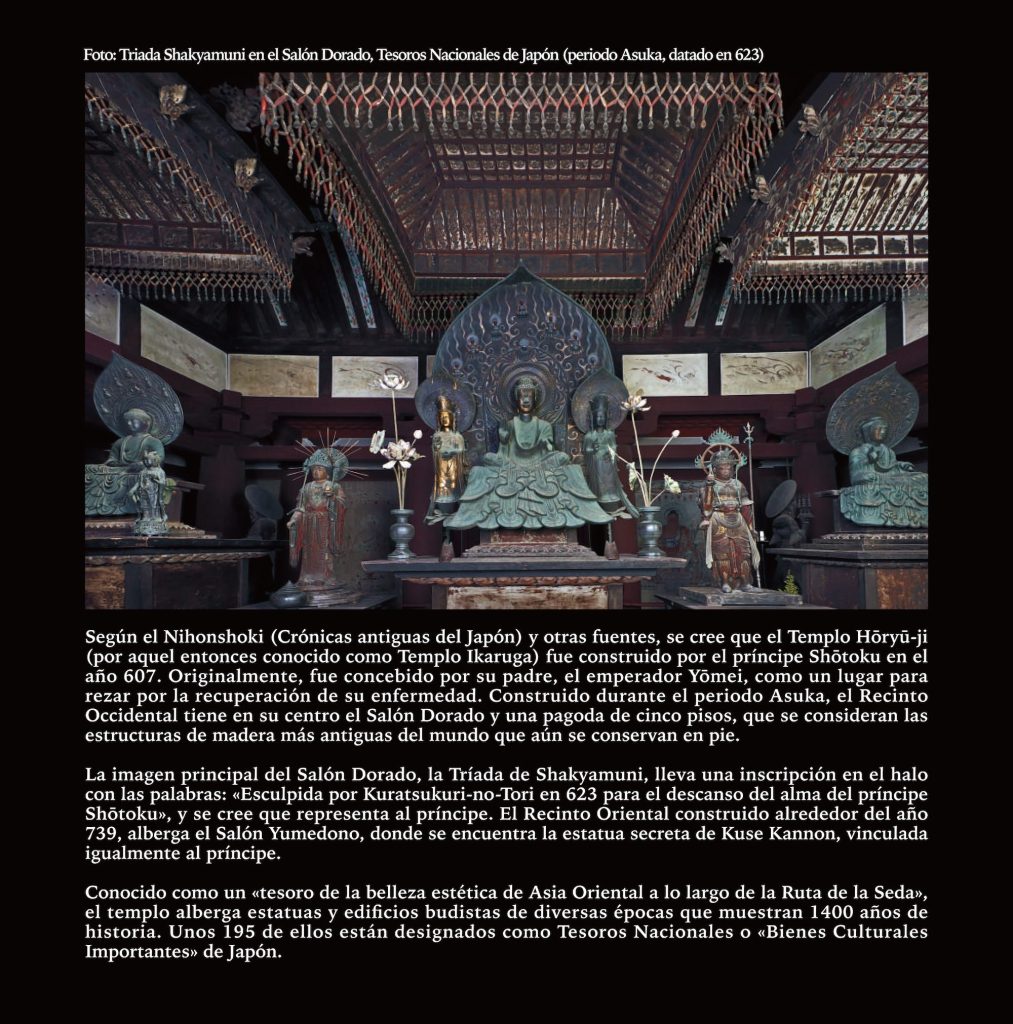
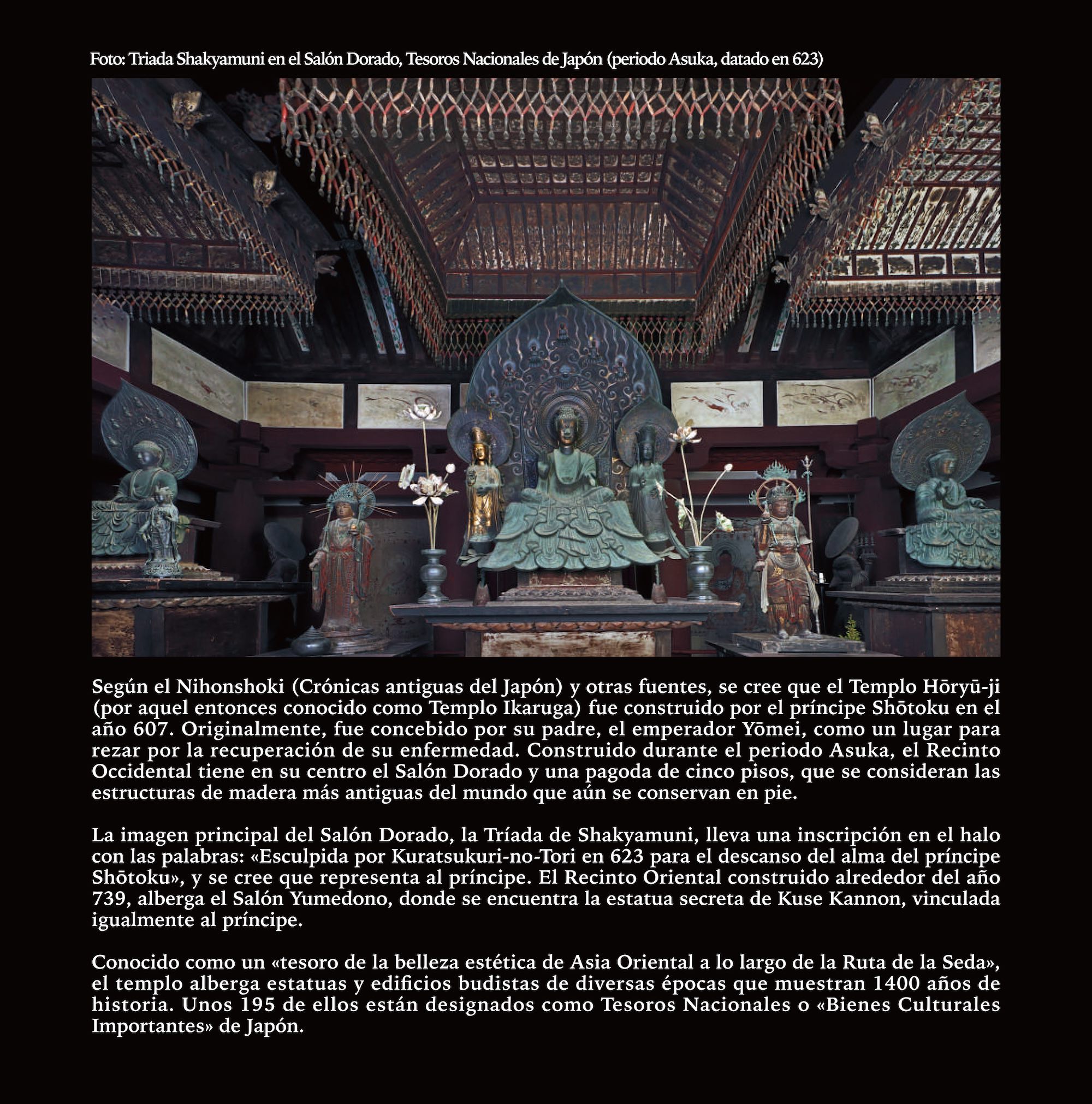
Prospectus: La importancia histórica del templo Hōryū-ji y el príncipe Shōtoku

Media = Art + Message No.15: JUST LAUNCHED—A project to spread Prince Shotoku’s ideal of harmony around the world

2026-04-21

🔸A World Premiere: the first photographic exhibition of the Hōryū-ji’s historical relics, to be shown outside Japan

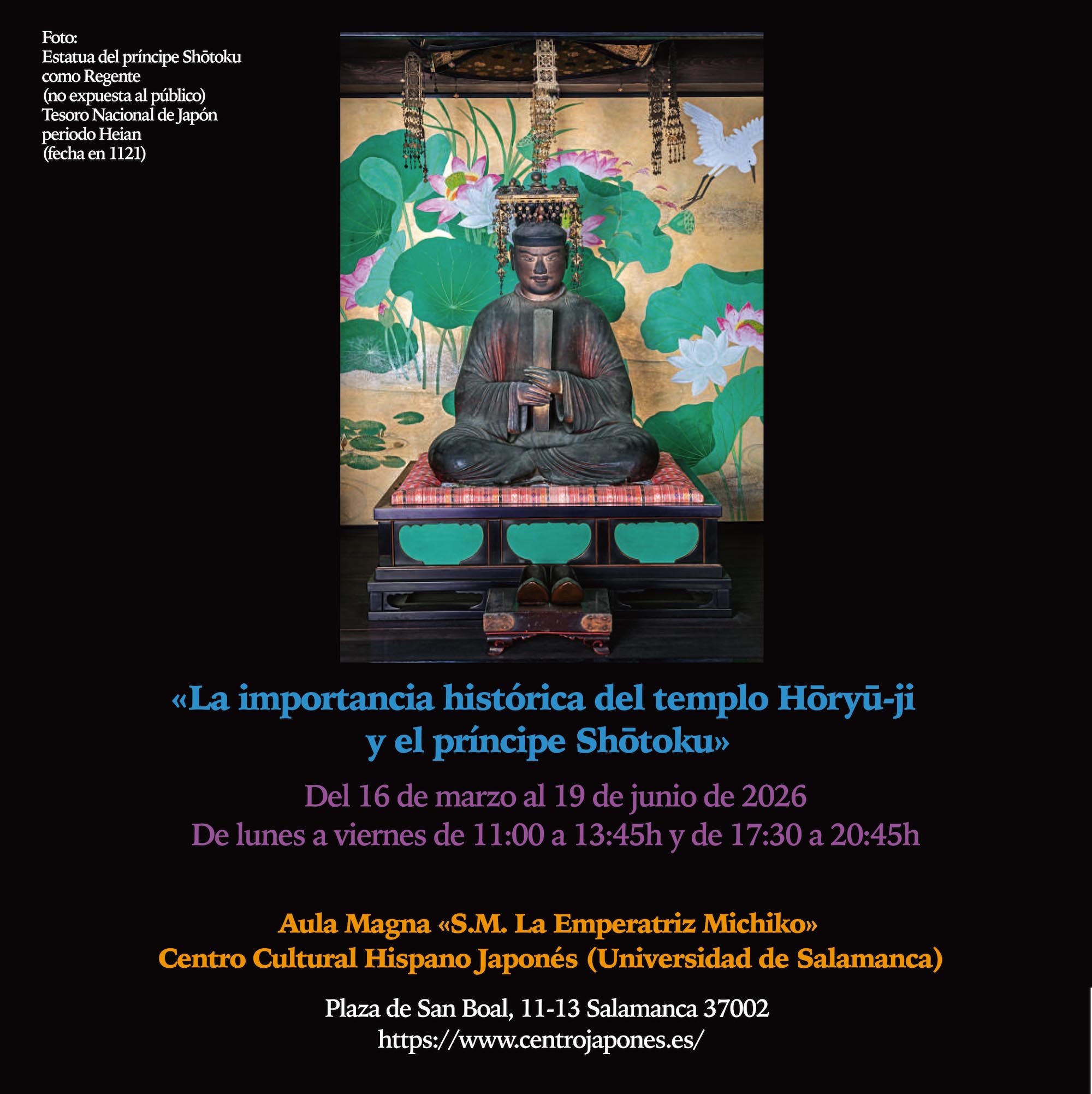
A photographic exhibition entitled ‘The Historical Significance of Hōryū-ji and Prince Shōtoku  (La importancia histórica del templo Hōryū-ji y el príncipe Shōtoku)’ opened at the Spanish-Japanese Cultural Center (University of Salamanca) in Spain on 16th March 2026. Amid growing global turmoil, this project aims to promote the spirit of ‘harmony’—that underpins the ‘Seventeen-Article Constitution’ promulgated by Crown Prince Shōtoku in 604—to the wider world. The required photography/filming work—for which exceptional permission was granted by the Hōryū-ji Temple—took 20 years to complete. This is the first exhibition of its kind to showcase the National Treasures of the Hōryū-ji, outside of Japan.

Poster: La importancia histórica del templo Hōryū-ji y el príncipe Shōtoku (Historical Significance of Hōryū-ji Temple and Prince Shōtoku)

Prospectus: La importancia histórica del templo Hōryū-ji y el príncipe Shōtoku

🔸Objectives

Through photographs and documentary footage showcasing the Hōryū-ji’s treasures and events, this exhibition explores the temple’s history at the eastern terminus of the Silk Road. Moreover, it places the achievements of Prince Shōtoku (Prince Umayato)—who laid the foundations for Japan’s politics and culture that continue to this day—within the context of East Asian history from the 7th century onwards..

A view of the exhibition in the “Empress Michiko Hall” (Photo: Japan Authentic Heritage Initiative)

A view of the exhibition “La importancia histórica del templo Hōryū-ji y el príncipe Shōtoku”
“Empress Michiko Hall” (Photo: Japan Authentic Heritage Initiative)

🔸Exhibited Work

The exhibition features photographic work and a video poem (15 minutes in Spanish) showcasing artefacts—that convey the grandeur of ancient East Asian Buddhism—which reached Nara via the Silk Roads. At the collection’s core are outstanding National Treasures from the Asuka period, including the Shakyamuni Triad, the Standing Statue of the Hidden Buddha, the Kuse Kannon, the Kudara Kannon, the Yumemichi Kannon, the Yakushi Nyorai, and the Four Heavenly Kings.

Prospectus: La importancia histórica del templo Hōryū-ji y el príncipe Shōtoku

A portion of the exhibition “La importancia histórica del templo Hōryū-ji y el príncipe Shōtoku”
“Empress Michiko Hall” (Photo: Japan Authentic Heritage Initiative)

A view of the exhibition “La importancia histórica del templo Hōryū-ji y el príncipe Shōtoku”
“Empress Michiko Hall” (Photo: Japan Authentic Heritage Initiative)

🔸Salamanca Japanese Culture Week

In 1999 the “Spanish-Japanese Cultural Center” (which includes the Empress Michiko Hall) was established at the Palace of Saint-Boire


The entire city of Salamanca was designated a UNESCO World Heritage Site in 1988. The Spanish-Japanese Cultural Centre was established there in 1999 as an annex to the University of Salamanca, which was founded in 1208 and is the fourth oldest still-existing university in the world. The centre’s ‘Empress Michiko Hall’ (formerly the Palais San Boileau), is the only cultural facility in the world permitted to bear the name of the former Empress of Japan. The annual ‘Salamanca Japanese Culture Week’, held here every year, serves as a focus for cultural exchange between Spain and Japan through exhibitions, lectures and concerts marking its 25th anniversary this year.

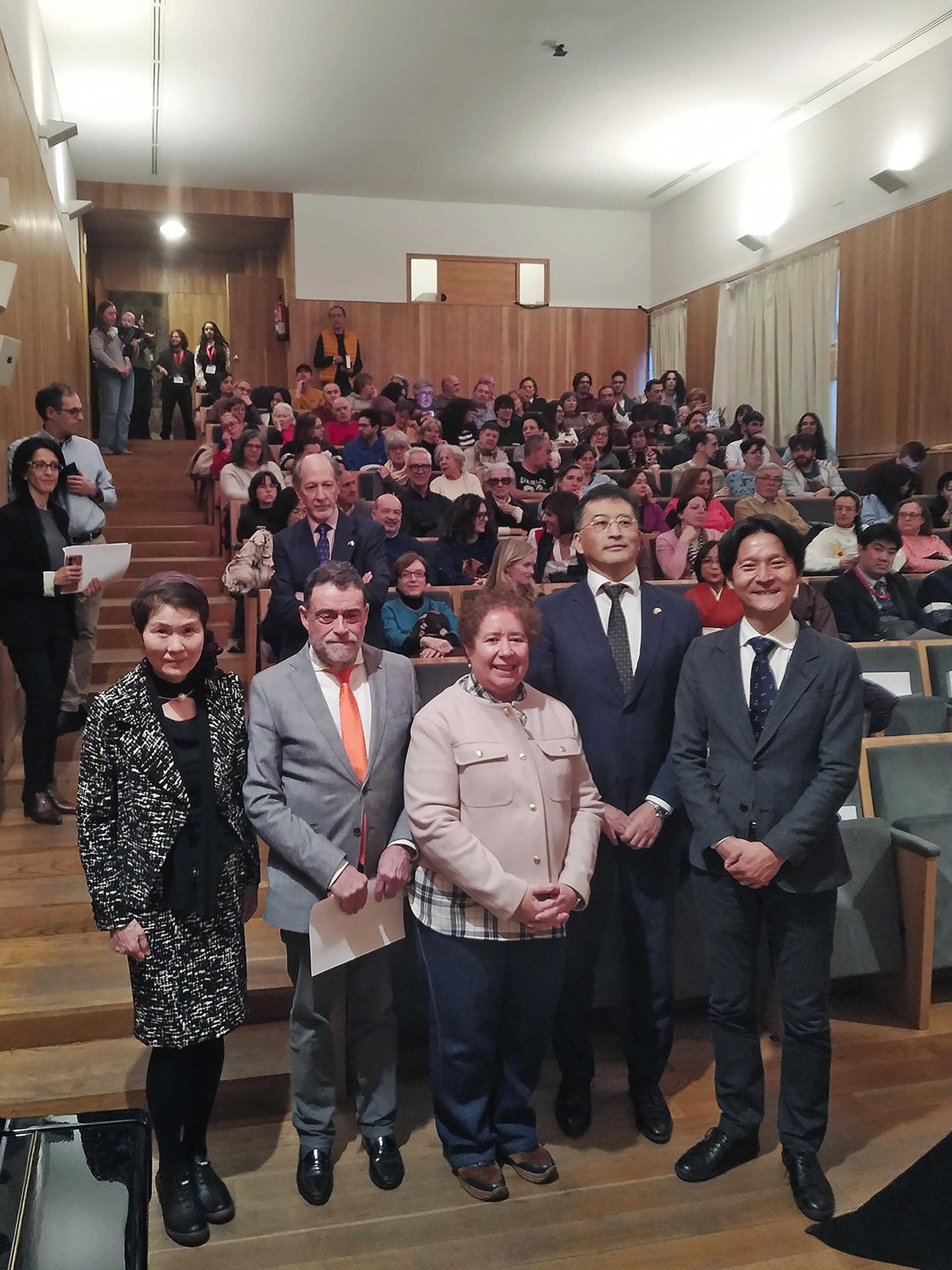
At the opening ceremony of the 25th Salamanca Japanese Cultural Week on 16 March, Professor Jose Abel Vilarejo of the University of Salamanca, Director of the Spanisch-Japanese Cultural Center, and Shinichi Sato, Charge d’Affaires at the Japanese Embassy in Spain, and Mr. Yasutaka Takeda, Director of the Japan Foundation, Madrid, delivered opening remarks. Following these, Miro Ito (Initiator of the Japan Authentic Heritage Initiative/Media Art League), photo-artist and producer of the Hōryū-ji exhibition, gave a speech.

At the opening of the 25th Salamanca Japanese Culture Week, 16 March 2026.
L to R: Ms. Ito; Director Floreso, the Spanish-Japanese Cultural Centre; Ms. Martinez, Vice-Rector for Cultural Assets, Heritage and Conservation at the University of Salamanca;
Mr. Sato, Chargé d’Affaires, Japanese Embassy and Director Takeda, Japan Foundation, Madrid (Photo: Centro Cultural Hispano Japonés, Universidad de Salamanca)

At the opening event of “La importancia histórica del templo Hōryū-ji y el príncipe Shōtoku”
(Photo: Centro Cultural Hispano Japonés, Universidad de Salamanca)


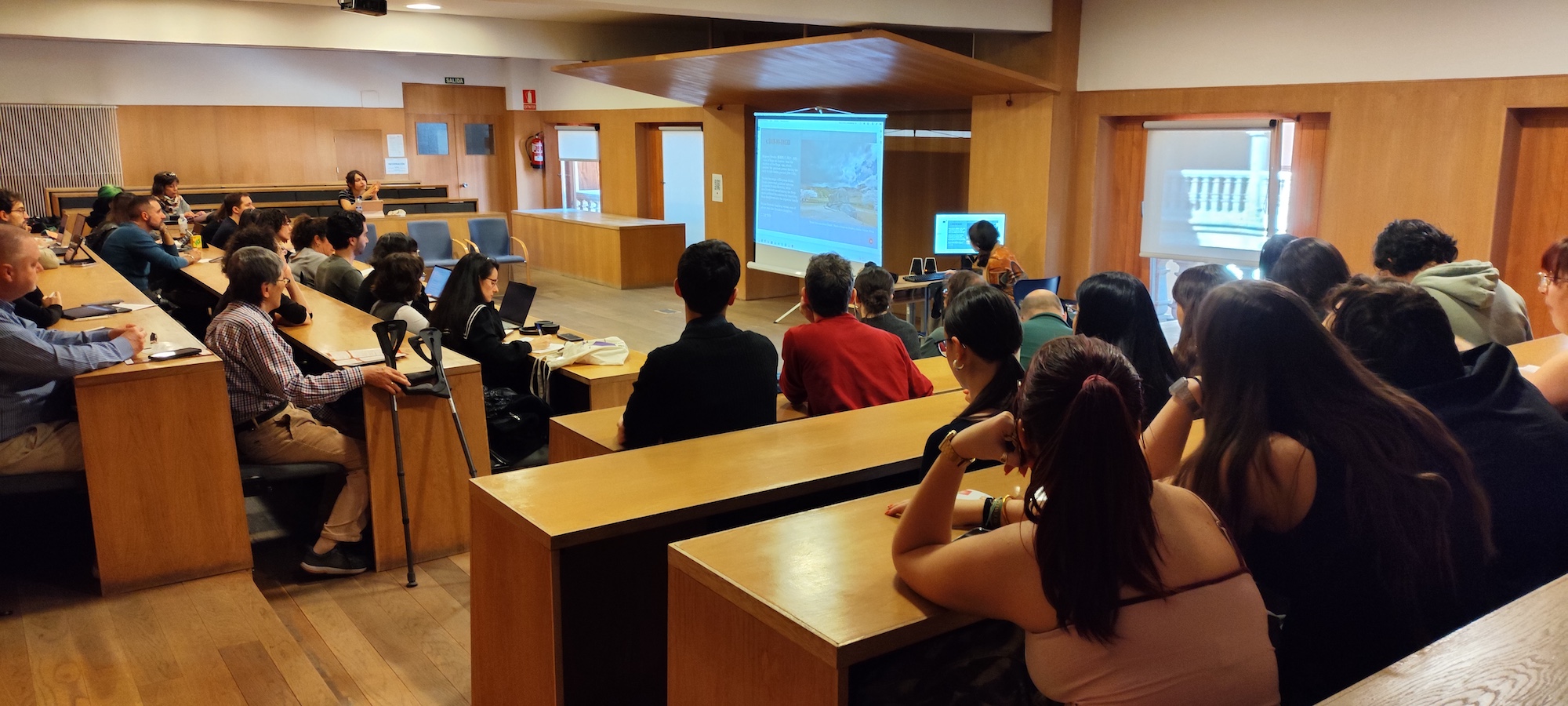
The next day, Ms. Ito gave a 50-minute lecture, “Two Sages of Japan: Prince Shōtoku and Emperor Shōmu”, to students of Japanese / East-Asian art and history, at the University of Salamanca. Her emphasis on Prince Shōtoku’s core value of “Harmony”, as the first and foremost of the 17-Articles in his Constitution, resonated well and garnered many remarks like “That is precisely the message the world needs today”.

Although parts of this lecture had been presented during Ito’s commemorative lecture in 2021 at Nara Prefecture’s Great Chrysanthemum Doll Exhibition, the current global tensions, gave the topic a particular relevance, as this appeal for harmony and understanding –transcending time and space– resonated well with the young Spaniards in attendance. Consequently, Miro Ito is determined to deliver similar messages at subsequent exhibitions in many countries around the world. She vowed “I will gladly travel anywhere in the world to spread this appeal for harmony and peace—should I be invited …”

A Commemorative lecture: “Two Sages of Japan: Prince Shōtoku and Emperor Shōmu (as part of a course at the University of Salamanca)
(Photo: Centro Cultural Hispano Japonés, Universidad de Salamanca)


The exhibition will run for three months until 19 June 2026.

Please do make a trip to Salamanca or Nara in Japan.

Organised by: The Spanish-Japanese Cultural Center, University of Salamanca(Centro Cultural Hispano Japonés, Universidad de Salamanca)

Co-organised by: Japan Camera Industry Institute, Japan Authentic Heritage Initiative

Concept and Production: Media Art League

Photo permits by: Hōryū-ji Temple

Photography, text and video by: Miro Ito

English editing by: Andreas Boettcher

Spanish editing by: The Spanish-Japanese Cultural Center, University of Salamanca

Endorsed by: Embassy of Japan in Spain; Japan Foundation, Madrid

Production of cine-poetry: Nara Prefecture

Funded by: The Tokyo Club


The Historical Significance of Hōryū-ji and Prince Shōtoku

(La importancia histórica del templo Hōryū-ji y el príncipe Shōtoku)

Centro Cultural Hispano Japonés (Universidad de Salamanca)

Dates: 16th March to 19th June 2026

Opening hours: Monday to Friday (11:00 AM to 1:45 PM, 5:30 PM to 8:45 PM)

Address: Pl. de San Boal, 13, 37002 Salamanca, Spain
Tel: +34 923 29 45 60
URL: https://www.centrojapones.es/exposicion-templo-horyuji-2026/

Prospectus: La importancia histórica del templo Hōryū-ji y el príncipe Shōtoku

Prospectus: La importancia histórica del templo Hōryū-ji y el príncipe Shōtoku

Media = Art + Message No.14: “Co-existing & Co-creating across Time and Space”—about our collective need to seek a guiding light based on Kegon philosophy

2024-03-03

On 25th February 2024, a lecture and film-screening event, in commemoration of 45 years China-Japan Peace and Friendship Treaty, was held in Tokyo’s Hibiya Library and Museum. Entitled “Co-existing & Co-creating across Time and Space”, it was successfully hosted by the JACCCO (Japan Asian Community Culture Cooperation Organization) with the able support of a diverse roster of participants.

After an opening greeting from former Prime Minister Yasuo Fukuda (Chair of JACCCO), the main theme of Kegon (Huayan) Buddhist philosophy was discussed by Zen Master Nanrei Yokota (Engaku-ji Temple in Kamakura), followed by my lecture and short-film about Todai-ji Temple’s Great Buddha (Nara) and Kegon Thought—I was able to summarise the past 20 years of my involvement with these themes.

Lecture & screening event: Co-existing & Co-creating across Time and Space (Hibiya Library & Museum, 25th Feb 2024/Photo: JACCCO)

Iconography of cosmic light as enlightenment

All things in the cosmos are inextricably interrelated—pratitya-samuputpada(immense knowledge of dependence of originating)—the essence of Kegon philosophy lies in the unity and cohesion of everyone and everything in the universe.

The flora and fauna; pebbles and planets; from the atom to the solar system; humankind and the world; the universe and the individual:indeed all is one and one is all.

Image: NASA

A dandelion spore—enlarged model showing its interconnected molecules
Image: Anna Chesnokova/iStock by Getty Images

The Buddha (literally: the enlightened one) is the Great Buddha itself; each of the lotus petals of its pedestal is engraved with a magnificent cosmic image of Buddha conceived 2500 years ago.

World of Lotus Sanctuary (Pedestal of Great Buddha Statue)
National Treasure of Japan, Mid 8th century
Hall of Great Buddha/ Tōdai-ji Temple, Nara

My presentation illustrated the drama of self-transformation through meditation and the wisdom that leads to a veritable cosmology embodied by the Great Buddha statue of Tōdai-ji Temple.

Cinepoetry: Great Buddha Lives! presented at the commemorative event of the 1300th anniversary of Heijō-kyō, Nara (Great Buddha statue of Tōdai-ji Temple Photo by Miro Ito)

Living in an age of tremendous turmoil

There was also a panel discussion with Zen Master Nanrei and myself, as well as Yuji Miyamoto, former Japanese Ambassador to China and Director of JACCCO, and Kiyoyuki Seguchi, Board Member of JACCCO—about our collective need to seek a guiding light based on Kegon philosophy—amidst the ongoing tremendous turmoil in the world today. All participants unanimously agreed on the importance of not straying from the path.

It was a meaningful forum for exchanging opinions from a variety of viewpoints such as religions, philosophy, politics and diplomacy.

Spring board to the next 20 years

To date, exhibitions and screenings of my work related to Todai-ji and the Great Buddha have been held around the world, including at United Nations Headquarters in New York, the Council of Europe in Strasbourg, the National Museum of World Cultures in Mexico City as well as the Byzantine & Christian Museum in Athens. Continuing this trajectory, the event last Sunday in Tokyo marked a new starting point for me for the next 20 years.

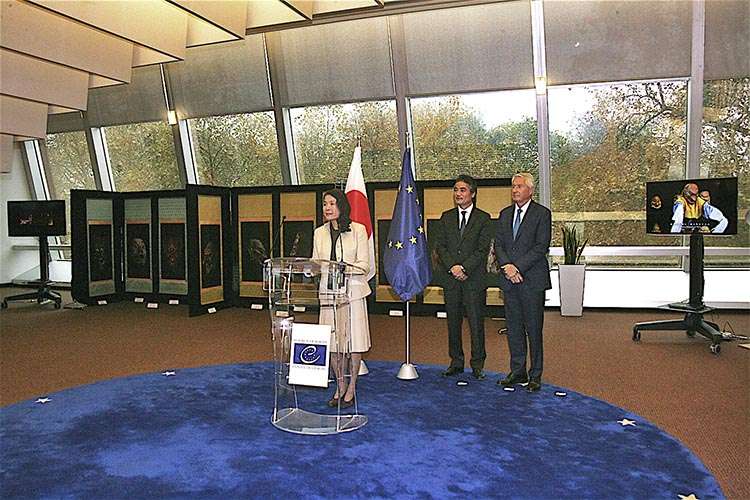
Speaking engagement at “Road of Light and Hope” exhibition by Miro Ito, the Council of Europe, Strasbourg, 2016 (from L to R) Miro Ito, Japanese Ambassador Shinsuke Shimizu and Mr. Thorbjørn Jagland (Secretary General, Council of Europe [at the time])

Indeed we have been planning to make a film on Kegon philosophy to promote global solidarity for a long time. Beginning this year, we would like to proceed to realise it.

We thank you for your interest and look forward to working with you.

Miro Ito

Media Art League/Japanese Authentic Heritage Initiative

Text and Images (C) Miro Ito/Media Art League. All Rights Reserved.


Media = Art + Message No.13 – New release of photo art book: Signs of the Intangible—Body-mind-scapes of Japan’s 1400 Years of Performing Arts (by MIRO ITO)

2023-05-26

Cover: Signs of the Intangible (by MIRO ITO)published by Media Art League

Media Art League/Japan Authentic Heritage Initiative published its first photo art book edition in early 2023: Signs of the Intangible collects a series of photographs by photo-artist Miro Ito—presenting a visual history of Japan’s 1400-year mind-and-body-unity culture from a unique perspective.

The 106 photographs include new and unpublished works together with newly-written art essays by the author herself: it also serves as the catalogue for the eponymous international exhibition series.

Gigaku Mask: Suiko-ju, Important Cultural Property of Japan, 8th century (Collection of Tōdai-ji Temple/Photo by Miro Ito)

Never-seen-before perspectives

The uniqueness of this presentation accentuates this unprecedented perspective on how these outstanding tangible or intangible arts and traditions interact: 8th century sculptures influenced by Hellenistic culture such as  Gigaku and Bugaku masks that came to Japan in the 6th-7th centuries via the ancient Silk Roads, Noh performance and Kobudo martial arts with their 600 year tradition as well as contemporary dance performances like Butoh.

Nurtured in a nature-worshipping environment (Shintōism) where everything is seen as a manifestation of kami, and influenced by Buddhism, the key element here is the continuity of the dedicatory tradition distinctly evident within the uniquely Japanese form of Shintō-Buddhist syncretism existing since the 7th century.

Quick Silver (Butoh Dancer: Ko Murobushi) Photo by Miro Ito

Seeking a path to enlightenment

From the 12th century, Zen Buddhist influences advanced an ideal of mind-body unity (shinjin ichinyo) that was cultivated, for example, by Dōgen Zenji as the path to enlightenment—not only in religious contexts but also—in performing arts like Noh and in martial arts such as Kobudo under the patronage of the samurai clans that dominated the shōgunate.

As another Zen Buddhist teacher, Hakuin put it “our soul has a physical dimension and our body has a spiritual dimension”, so the body is the ba (topos or place) for such transformation toward its ultimate goal of gedatsu (liberation: vimokṣa in Sanskrit) intrinsic to Oriental ascetic tradition and meditation.

It is our hope that the Signs of the Intangible may provide glimpses of evidence for East-West exchange—going back centuries—and the long history of Japanese performing arts while pursuing a road to enlightenment embedded in the deep layers of Japanese culture.

Perhaps this work will give an impetus to the reader to direct their gaze to the horizon of unknown possibilities that the body opens up.

Noh play Atsumori (Noh Actor: Fumiyuki Takeda) Photo by Miro Ito

Inspirations that the body can unlock

This book presents mind-and- body-scapes woven by “distant yet close body expression”(1), for which 1400 years of Japanese performing arts serve as an example—ranging from Gigaku/Bugaku to Nogaku, to Butoh, to modern dance, and even to mixed media performing arts.

Could it not then be, then, that by dedicating oneself via the corporeal body to the truly great and sacred, one could become one with the universe?

In the end, as a common aspiration of all humankind—regardless of religion or ethnicity—may a true awareness that we all are one spread and take root in the hearts of everyone so that it may be shared throughout this world of seemingly never-ending strife.

26th May 2023

Miro Ito & Media Art League

(*1—quote from Ko Murobushi)

Time Theatre, Gunkanjima Island (Butoh Dancer: KiK_7) Photo by Miro Ito

inter/action (Dancers: Sal Vanilla) Photo by Miro Ito


Proceeds from the sales of photo books help fund public relations activities for Japanese culture and the creation of supporting media such as books and films, to promote awareness for Japanese culture around the world. These will also be available for collaborations with museums and educational/research institutions worldwide.

See more in details and how to order books on our Website and Flyer: Japan Authentic Heritage Initiative

Photo Art Book Signs of the Intangible by MIRO ITO

Download Flyer: sings_of_the_intangible_by_miroito_230519_compressed

For Inquiries: info@japan-authentic-heritage-initiative.org

Media = Art + Message No.12: Pioneering the Environmental Revolution with love and responsibility towards the Earth and one another

2022-01-01

It is I, Sea Gull — Medallion of the first woman to go to space, Valentina Tereshkova in the the Cosmonaut Station, Tashkent/Uzbekistan, superimposed on the Earth as a time piece (Image by Miro Ito)


In 2021, the world once again faced so many daunting challenges, first and foremost the battle against the Covid-19 pandemic, worsening climate change, the makings of a new Cold War amidst conflicts over nuclear weapons treaties and the intensifying refugee problems.

It is becoming more and more apparent that these ordeals are not the concern of individual nations, but universal crises impacting the entire planet.

In particular, if we regard natural catastrophes as warning signs from Mother Nature, the universal law that everyone is one and all are one appears self-evident!

We all live on Mother Earth, we breathe the same air and are embraced by the same seas and skies.


Tear drop from the blue planet (Image by Miro Ito)


It is time to make a paradigm shift, from a civilisation that prioritises production, consumption, efficiency, and profits, to a new world order that prioritises balance with the environment, based on the principles of equitable circulation, distribution, and sharing.

We need to look at the current situations from a new perspective that puts the earth first, and rearrange the priorities in our lives.

It is now the dawn of a new era that can be called the environmental revolution, following the industrial revolution and the IT revolution.

We are indeed responsible for the sustainability of the planet for the future and how human history will evolve further on.

We believe that accepting this responsibility for the future by fostering love, creativity and development in a way that benefits the world is a new pioneering spirit for a new era.

Praying that love, responsibility and creativity will become the keywords of this new era…

1st January 2022

Miro Ito & Media Art League

Media = Art + Message No.7— Sympathy for all life: Speaking engagements in Rio and Mexico

2018-12-02

Road of Light and Hope
Museo Nacional de las Culturas del Mundo (National Museum of the World Culture)

Chain of Sympathy

Not only calamity and blight, the roots of war and poverty, but also imminent issues like the increasing tendency of social, regional and global fragmentation, or environmental pollution and global warming, cannot be frozen in time. They must be addressed now and we must treat the Earth as if it were one precious life and foster solidarity by truly empathizing with each other.

To determine our future is to act with sympathy; being part of the problems, we now must be part of the solution. Even though the empathy of one individual may only be a tiny ripple, it can resonate through the whole world as through a tuning fork…

Just as a pebble exists on the ground, so does a star in the cosmos. A pebble, star, plant, animal, or human, all complement and support each other as fellow travelers. This Weltanschauung universally permeates East and West, North and South…

“Split a piece of wood and I am there, Lift a stone and you will find me” (Jesus, in the Gospel of Thomas, Nag Hammadi Collection)

This common wisdom of West and East should be the guideline of our actions with   empathy for all forms of life on our Blue Planet, where a speck of dust as well as the endlessly vast universe can both be regarded as ONE.


“All is one and one is all”

With the kind support of the Japanese Ministry of Foreign Affairs as well as the Japan Foundation, following the invitation of the “Road of Light and Hope” exhibition series to various events or cultural institutes commemorating milestones in Japan’s relations with other nations, it is a great honour for me to have growing speaking engagements in those contexts. (*co-organized by Japanese overseas missions, the Japan Foundation, Media Art League, Japan Camera Industry Institute, etc.)

What began with a speech at the Council of Europe in 2016, is continuing with “Artist’s Talks” at the Japan Foundation Toronto, workshops at the University of Chicago, lectures at the opening event of the “Japan Month” in Rio de Janeiro and in Mexico City in November 2018…

My recurring themes are from Eastern Kegon (Hua-yen) philosophy which has much in common with Western Neo-Platonism including the notion that “All is one and one is all” that the universe is “one living entity” and that there is sympathy (συμπαθεια) within everything (Neo-Platonism).

In order to inspire such sympathy between East and West, my intention is to focus —via photo exhibitions, movie screenings and lectures— on select ancient tangible and intangible World Cultural Heritage of Japan, which reflects the legacy of Hellenistic cultural influences in Nara.

Showing photographic art work of outstanding National treasures of Japan and  Important Cultural Property, that can be traced as far back as 14 centuries ago, as “evidence” to connect the cultural origins of West and East transcending the Silk Roads, our activities are intended to convey the message that we all are one and all is interconnected.


Speaking Engagements in Rio and Mexico City

In July, I had the honour of holding a lecture with short movie screenings at the opening event of the “Japan Month” at the venue of my “Road of Light and Hope” exhibition (Cultural Center Correios Rio de Janerio) in commemoration of the 110th anniversary of the Japanese immigration to Brazil.  After the event, the former American Consul General expressed her sympathy for my message which she took as an inspiration. Moreover, what I experienced at the Rio de Janeiro State University enhanced my conviction on the importance to point out the ancient cultural interrelations of West and East. In the end, the “Japan Month” in Rio had 62,000 visitors over three and a half weeks.

Lecture at the opening event of “Japan Month” in Rio

On 8th November 2018, the memorial event to commemorate the 130th anniversary of the establishment of diplomatic relations between Japan and Mexico was held at the National Museum of the World Cultures in Mexico City. This event is showing Japanese   culture in an extent as has not been seen in recent years. As my “Road of Light and Hope” exhibition was also invited, I had an opportunity to speak, following introductions by Japanese Minister to Mexico, Ryosuke Kuwana as well as Ms. Naoko Sugimoto, Director of Japan Foundation Mexico. On the following day, I held an affiliated lecture to the exhibition at the Museum Library. The chain of sympathy will hopefully extend further to Mexico via this exhibition which still runs until 3rd December 2018)…

Connecting ourselves with the history of East and West, and with the sympathy of and for the globe…

Miro Ito (artist & author, producer & director/Media Art League)

Lecture for “Road of Light and Hope’ exhibition, Museo Nacional de las Culturas de Mundo, Mexico City

Media = Art + Message #6 — “Signs of the Intangible”– the quest for mind-body-scapes in Japanese dedicatory tradition

2018-06-09


Signs of the Intangible, Japanese Canadian Culture Centre, Toronto

Signs of the Intangible

Bodyscapes reflecting Japan’s 1400 Years of Performing Arts by Miro Ito 

Photo Exhibition, Artist Talk & Short Film Screenings

Commemorating the 90th Anniversary of Diplomatic Relations between Canada and Japan, our new exhibition“Signs of the Intangible” can be experienced at the Japanese Canadian Centre in Toronto. Co-organized by Media Art League and Japan Camera Industry Institute, this presentation showcases the 1400 years of continuity in Japan’s performing arts in exquisite photographs as well as short film format.

It features 55 outstanding photographic images of select National Treasures of Japan, as well as UNESCO Intangible Cultural Heritage such as Noh performers, or avant-garde Butoh dancers as well as contemporary dancers. Topical film shorts by Miro Ito will also be shown.

The uniqueness of this presentation accentuates a “never-seen-before” perspective on how these exceptional tangible or intangible arts and traditions interact: 8th century Buddhist sculptures influenced by Hellenistic culture, Gigaku and Bugaku masks (that came to Japan in the 7th century via the Silk Road), Noh performance and Kobudo martial arts with their 600 year tradition, as well as contemporary dance performances like Butoh.


[Artist Talk & Reception]
Thursday, 21st June 2018 @7:00 PM (Telephone reservations are recommended)

— Word of greeting from Consul General Takako Ito
— Artist Talk & Short Film Screenings by Miro Ito, Media Art League
— Solo Performance of Gigaku Ballet combined with Konron mask by Shunso  (Artistic Direction by Miro Ito / Music by Sukeyasu Shiba)


[Duration & Venue]

Preliminary viewing start: Thurs., 23rd May 2018

Artist Talk & Reception: Thurs., 21 June 2018 (7:00 PM)

Last day: Wed., 27th June, 2018
Opening Hours: 9:00AM – 8:00PM (daily)

Japanese Canadian Cultural Centre
6 Garamond Court, Toronto, ON, M3C 1Z5    Tel.(416) 441-2345  http://www.jccc.on.ca/en/

※Click to download the exhibition poster in PDF:_signs_of_the_intangible_poster_2018June11


Searching for an Ideal of mind-body unity

Nurtured in a nature worshipping environment (Shintoism) where everything is seen as a manifestation of kami, and influenced by Buddhism, the key element that provides continuity is the dedicatory tradition evident in the Shinto-Buddhist syncretism prevalent in Japan since the 7th century.

From the 12th century onward, Zen Buddhist influences, advanced an ideal of mind-body unity called “shinshin ichinyo“, as the path to emancipation/liberation (gedatsu) — not only in religious contexts, but also —- in performing arts like Noh and in martial arts, such as Kobudo, under the patronage of the samurai clans that inherited the shogunate.

As Zen Buddhist teacher, Hakuin put it “our soul has a physical dimension and our body has a spiritual dimension”, so the body is the “ba” (topos) for the transformation towards an ultimate goal of “gedatsu” (lvimokṣa in Sanskrit) in Oriental ascetic tradition and meditation.


Icons of Unity for East and West

This project’s unique perspective pursues the foundations of the profundity of Japanese culture as well as the origins of various types of Japanese performing arts as an enduring legacy of ancient cultures from the Eurasian continent.

Evidently, the origins of many Asian sculpting traditions can be traced back to statues (Άγαλ&α) dedicated to ancient Greek deities. This presentation, “Signs of the Intangible” showcases select artwork as “evidence of the interconnectedness of East and West”.

Finding common ground transcending the Eurasian continent within the cultural heritage along the Silk Road may present a ray of hope for one day realizing true unity and solidarity among mankind…

This is the very essence of the messages enciphered in the history of 1400 years of Japanese Performing Arts.


Co-organizers: Media Art League and Japan Camera Industry Institute
Host: Japanese Canadian Cultural Centre
Exhibits: 55 Photographic Images by Miro ITO (Media Art League)
Project Management & English Editing: Andreas Boettcher (Media Art League)

Special Permission: Tōdai-ji Temple, Kasuga-taisha Shrine, Nara National Museum

Participating Performers: Hodaka KOMPARU, Yukifusa TAKEDA, Tomoyuki TAKEDA, Fumiyuki TAKEDA, Ko MUROBUSHI, Sal Vanilla, Shunso

Exhibits of Photographic Art in Scroll Format: Tenpyō era sculptures of Tōdai-ji Temple (National Treasures of Japan) , Gigaku masks of Tōdai-ji Temple (Important Cultural Property), Bugaku masks of Kasuga-taisha Shrine (Important Cultural Property)

Support by: The Consulate-General of Japan in Toronto, the National Federation of UNESCO Associations in JAPAN, the Tokyo Club, Nara Visitors Bureau, etc.


Text by Media Art League. Photographs: Miro Ito. All Rights Reserved.

Media = Art + Message #5 —Dreams of a Gigaku Mask

2018-02-18

Media = Art + Message #5 —Dreams of a Gigaku Mask:

Extensively, Leisurely Observing to the Farthest Horizon.


Celebrating Lunar New Year  2018!

After 2017 ended as a year where the fragmentation of the humankind became ever more evident, there can be no hope of a brighter future ahead unless people all over the globe, truly become one.

Amidst the seemingly never ending conflicts whose seeds lie in prejudice, hate and fear, we can share the aspirations and ideals of contributing to the unity of the world in every possible way, as currently demonstrated by the Olympic ideals we are witnessing in Korea.

On the occasion of this Lunar New Year, the words of the late Kyōgen Master and fellow artist, Mannojo Nomura V. come to mind:  “extensively, leisurely observing to the farthest horizon”.

Whether it be on ecological issues or on the various ongoing conflicts around the globe, a sound conscience and consciousness for solutions can be fostered by having a broad perspective that encompasses both past and future.

As part of this initiative of mine, I have had opportunities to speak about what I call “the road of wisdom transcending East and West” at the University of Chicago last November. My main theme was the universalism in art form found in the Hellenistic sculptures of the Tōdai-ji Temple from the 8th century, photographs of which were presented in my concurrent exhibition in Chicago.

In a religious sense, universalism is the teaching of universal salvation. In its broadest sense, it represents an ideal to affirm and respect each other’s differences based on the universal idea that: all is one.

Vestiges of these ideals can be recognized in such performing arts as Gigaku that came to Japan more than 1400 years ago via the Silk Road. The remarkable co-existence of heterogeneous cultures is reflected in their masks as the embodiment of the essence of universalism in the form of art.


Like a Miniature Pantheon…

My globally touring exhibition, “Road of Light and Hope” that launched at UN headquarters in New York in 2016, was subsequently shown at the Academy of Arts of Uzbekistan, the Council of Europe and the Lieu d’Europe in Strasbourg, the Japan Foundation in Toronto, the Japanese Consulate General in Chicago, with the gracious support of co-organizers: the Japanese Ministry of Foreign Affairs and Japan Camera Industry Institute.

Gigaku masks were enthusiastically welcomed at various venues and fascinated visitors with their magnificent and vibrant artistic expressions.

Incidentally, an inebriated Sogdian King (Suikou), one of the representative Gigaku characters is believed to be modeled after Dionȳsos in Greek mythology. (The Sogdians once inhabited an area that roughly corresponds to today’s Uzbekistan).

In fact, Central Asian countries were crossroads of civilization where a panoply of ethnicities and nationalities intermingled. Uzbekistan itself is a veritable “racial melting pot” which is reflected in the facial features of many of its inhabitants today. Since the historic Greek immigration after the eastward incursions of Alexander the Great, a human tapestry of myriad ethnicities co-existed for over 2300 years, allowing the spirit of Gigaku to thrive.

Gigaku —considered to be the oldest form of mask theater on the Eurasian continent—  is derived from that of ancient Greece. Although it long fell into disuse as an actual performing art, around 552 AD when Buddhism was first introduced to Japan, Gigaku also arrived. Then Gigaku came to be performed as dedicatory dances for religious rituals at major temples in Japan’s first capital, ancient Nara.

When observing Gigaku masks, it is almost like encountering the spirits of our ancestors. Like a miniature Greek Pantheon, the masks represent various deities and tribal rulers, hermits as well as historical heroes inspiring us to find the way to a harmonious future…

With a heartfelt prayer for peace


Miro Ito

Media Art League

East Meets West through “Media = Art + Message”

http://mediaartleague.org/en

(C) Text and Photo by Miro Ito / Media Art League. All Rights Reserved.

Photo by Miro Ito (Replica of  an original Gigaku mask owned by the Todai-ji Temple: Karura; carved in the early 17th century)

Media = Art + Message #4 ー Art as Power to Foster Universality

2017-10-28

Exhibition: Road of Light and Hope

National Treasures of Todai-ji Temple, Nara  Photographs by Miro Ito

Consulate-General of Japan in Chicago, 1st – 28th Nov.2018


Our globally touring exhibition series, “Road of Light and Hope: National Treasures of Todai-ji Temple, Nara / Photographs by Miro Ito” will start its next VISIT in Chicago 1st November 2017.  Commemorating the 120-year history of the Consulate General of Japan in Chicago, this exhibition will run until 28th November presenting 41 photo art works in scroll format, featuring prominent 8th century Tenpyo era sculptural masterpieces owned by the Todai-ji Temple, that are truly rare National Treasures of Japan.


Paragon of resilience

Previously an exhibition, “The Great Eastern Temple: Treasures of Japanese Buddhist Art from Todai-ji” was held at the Art Institute of Chicago in 1986. Although 30 years have passed since then, the enduring existence of these 1300-year-old treasures shines a ray of hope to art aficionados even today.

In an era where hardships such as natural disasters, famine and blight; kept recurring, similar to the present time, singular events such as the historical one of erecting the Vairocana Buddha 1300 years ago which nearly half of Japan’s able population of 5 million at the time endorsed.

Moreover, although the Great Buddha statue was destroyed twice during war, it was miraculously restored in the 12th and 18th centuries, which many Japanese see as a paragon of resilience.  Today it constitutes part of the UNESCO World Heritage Site: Historic Monuments of Ancient Nara**.

The custom of crafting larger-than-life statues representing the enlightened Gautama Buddha himself originated along the Silk Road in Central Asia. I firmly believe that these imposing giant statues — from the 15 metre-high Great Buddha of Nara to the 30 metre-tall Christ the Redeemer statue in Rio— with their profound religious symbolism exude a sort of power that can unite people’s hearts. Both Buddha and Christ were opposed to their followers creating or worshipping statues of them. Nonetheless, they make us aware that only humanity has the urge to pray.


Power of universality

This power of universality found in many works of art is the theme that I would like to address in my prospective lectures at two universities in Chicago, in the context of the coming photo exhibition of National Treasures of Todai-ji Temple.

For example at the University of Chicago, I will hold a workshop-style lecture; Visual and Material Perspectives on East Asia, where artists / historians/ aesthetics / creators present their perspectives on respective visual material. I would like to talk about the universality that art can embody and convey —transcending 1300 years of history— to our 21st century world.

Namely, I would like to advocate the power of universality in art to foster unity and tolerance that is reflected in the 1300-year cultural heritage from the Silk Road.


The universality of art

Essentially, the universality in nature permeates everything as well as the fundamental truth that all humans are created equal despite any differences in appearance or customs.

This is the very basis of our consciousness for accepting diversity. For example, such marvelous examples of the acceptance and co-existence of diversity can be found in Gigaku masks with 14 types of characters including

a king of the Sogdian traders along the Oasis Road, Konron, a hermit of the Kunlun Mountains, Karura/ Garuda, man-bird deity, etc. Through this ancient cultural heritage brought from along the Silk Road, we can encounter with a newfound sense of appreciation that comes from universality, transcending time and space, feeling that “every one of us is an indispensable flower”.

Embodying one of the most important core philosophies of Hua-yen (Kegon) Buddhism, this is  why the Great Vairocana Buddha was erected by Emperor Shomu in 752 AD.


The mecca of the US modernism movement 

As for Chicago, this city is the center of modernism in the fields of architecture, design and photography in the USA. For example, Lazlo Moholy=Nagy, a photographer, typographer, painter, and educator came to Chicago, after leaving the legendary Bauhaus, the German national school of art closed down by the Nazis in 1933. There he founded the New Bauhaus (later integrated into the Illinois Institute of Technology [IIT]). Its leading modern architect, Mies van der Rohe became Director of the School of Architecture at Chicago’s Armour Institute (later IIT) in 1937.

The Bauhaus in its own right embraced the spirit that art changes society, born of the Central-European revolutionary socialist movements forming in Germany, Hungary and Czechoslovakia in 1920’s.

In the field of photography, Construction, Movement and Light were the dominant themes in its bold formative and visual experiments. In architecture, the Bauhaus aimed to establish a rational functionalist style, having pronounced similarities with the Sukiya-zukuri or Shoin-zukuri of Japanese architectural styles of Samurai residences during the medieval to early modern eras. Bauhaus-dominated modernist architecture thus has many elements in common with Japanese traditional architecture.

As for the assertion that art changes the world central to the 1920’s movement of modernism, if art can change the world, I believe that very key for such change should be the message of “universality”.


Universal Heart & Mind

Incidentally, the concept of “universal space” was first proposed by one of the three great modern architects, Mies van der Rohe, whereby a wide variety of functions can be allocated in a large long-span single space. Similarly, in today’s architecture and design sectors, the concept of “universal design” applies to accessibility for everyone, regardless of age or ability.

In a similar sense, the universality of mind & heart must apply to everyone. For this to be achieved, we must respect and accept everyone’s inherent differences, and consciously strive for solidarity rather than segregation, tolerance rather than discrimination, compassion rather than hate.

Coming back to the National Treasures of the Todai-ji Temple, although the Great Buddha statue was destroyed twice, it could be reconstructed both times only because the statue and the task of its reconstruction made people adhere to the above principles, dedicating their hearts & minds to perform a miracle that only universality can foster.

Of course, this is but one example from my own culture. There are numerous statues, monuments and buildings around the world that could only be saved or restored due to people’s power of prayer for peace.

My core message is that everyone, every individual, is an indispensable and invaluable flower –none worth more than the other…


Gigaku + Ballet

Besides sending this message, this appeal for solidarity, compassion and understanding, we at Media Art League are going to hold a special opening event on the night of 1st Nov. (18:00 -19:00) at JIC Hall, Consulate-General Chicago.

We are going to show two short movies that we produced, accompanied by an exceptionally rare Gigaku + Ballet performance by fellow artist, ballet dancer/performer, Shunso.

Gigaku is the enigmatic mask theater with a 1400 year-old tradition that can be traced back to ancient Greek mask theatre, which had once been lost but survived with 14 character masks only in Japan; at major temples in Nara such as the Todai-ji and Horyuji.

We are revisiting it as a Ballet mini performance, seeking to connect our common cultural origins in East and West. The core message being: we all are one.

Should you have any chance to come to Chicago from 1st to 28th of November, please visit my touring exhibition in Chicago.

We would like to welcome you from the bottom of our hearts.


Miro Ito

artist & author, initiator of Media Art League

Please click here to download the exhibition flyer.

chicago_exhibition_17Oct06


Referral links:

Consulate-General of Chicago / Japan Information Center Hall

http://www.chicago.us.emb-japan.go.jp/itpr_en/jic.html


University of Chicago – Visual and Material Perspectives on East Asia

https://voices.uchicago.edu/vmpea/

← Older posts

News

  • Announcement: Tōdai-ji Photo Exhibition ‘Road of Light and Hope’ (by Miro Ito) begins on 29th Sept.2026 at University of Salamanca 2026-09-29
  • Announcement: ‘The Historical Significance of the Hōryū-ji Temple and Prince Shōtoku’—A Photo Exhibition by MIRO ITO 2026-03-21
  • Year of the Horse / Unicorn: New Year Message for 2026 2026-01-01

Blog

  • Media + Art = Message No.17: Emperor Shōmu’s True Motives for the Construction of the Great Buddha—‘For a world in which all things—flora and fauna alike—may flourish’ 2026-10-17
  • Media + Art = Message No.16: Quest for the wisdom of our forebears seeking global harmony―Miro Ito’s Hōryū-ji photo exhibition at the University of Salamanca in Spain runs until 19 June 2026 2026-06-06
  • Media = Art + Message No.15: JUST LAUNCHED—A project to spread Prince Shotoku’s ideal of harmony around the world 2026-04-21
Menu   ≡ ╳
  • JAPANESE
  • HOME
  • Introduction
    • Mission
    • Objective
    • Activities
    • Chronology
    • Clients
  • Our Work
    • Screenings
    • Photo Exhibitions
    • Book Projects
    • Media Coverage
    • Media Contributions
    • Media Assignments
  • Creative Projects
    • Artwork Production
    • CSR Projects
    • Photography Projects
    • Web Media Production
    • Design Projects
  • Publishing & Educational Activities
    • Publishing Activities
    • Book Publications
    • Book Reviews & Interviews
    • Photography Textbooks & Essays
    • Lectures & Workshops
  • International Communications
    • International Editorial Contributions
    • Research Projects
    • High End Translation
    • Clients
    • Profile of Andreas Boettcher
  • MIRO ITO + NPO Activity
    • Mission Statement
    • Purport & Objective
    • Activities & Structural Configuration
    • Founding, Vision & Contribution
  • News
  • Blog
  • Contact
Media Art League /en
▲
  • Facebook
Copyright © 2015-2023 Miro Ito & Media Art League. All rights reserved.
Concept & Direction by Media Art League
Original Japanese Text & Images by Miro Ito
English Text by Andreas Boettcher
Web Design by Masafumi Umetsu